Overview
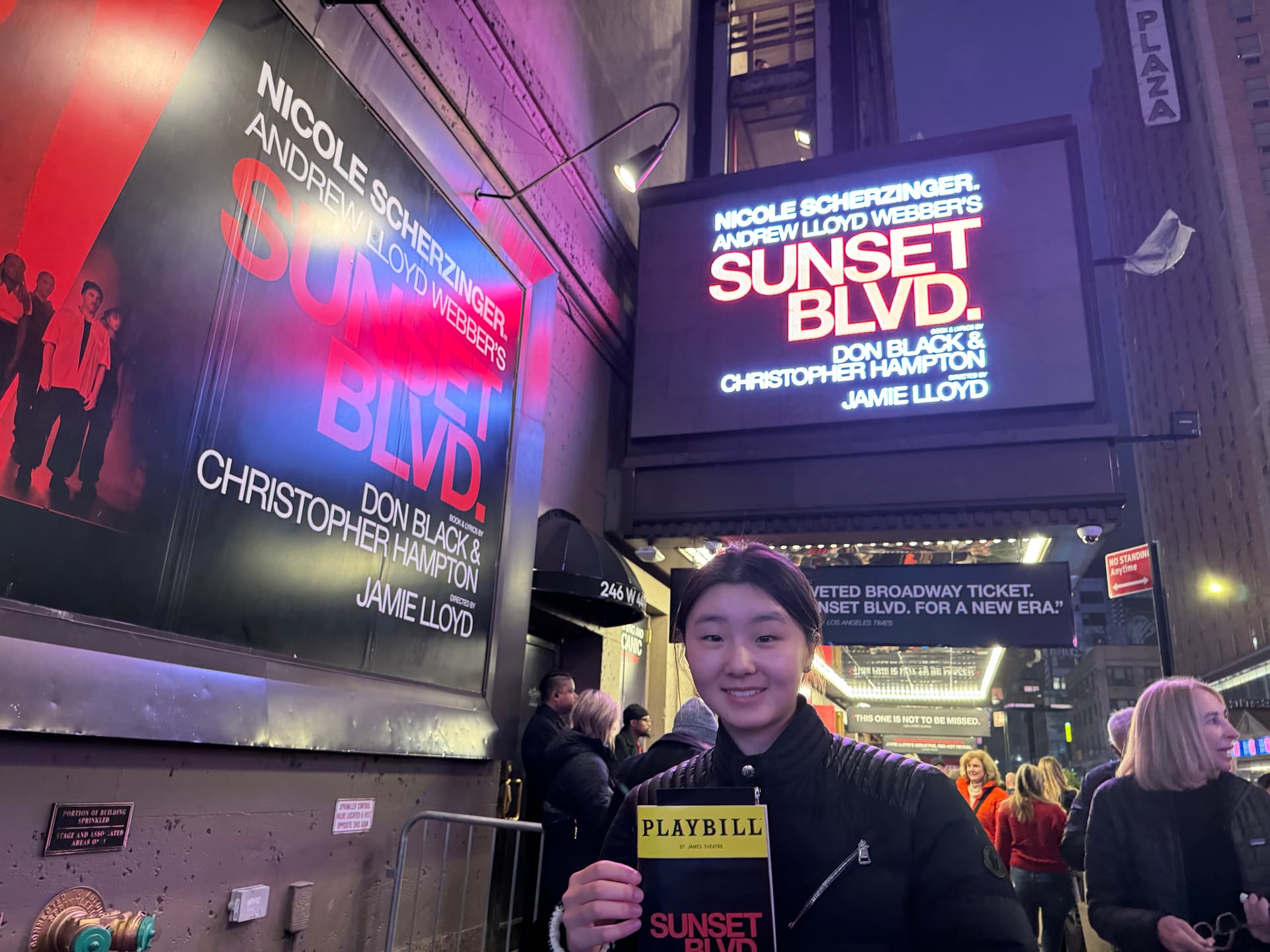
When Jamie Lloyd's Sunset Boulevard opened in London in 2023 and transferred to Broadway's St. James Theatre in October 2024, it did something that initially seemed almost contradictory: it revived a musical famous for Hollywood glamour by removing almost all of the glamour. Earlier productions of Sunset Boulevard had often emphasized spectacle. Norma Desmond's mansion could dominate the stage. Costumes evoked old Hollywood extravagance. The physical production helped create the decaying luxury of a forgotten silent-film star living inside memories of her own celebrity. Jamie Lloyd stripped almost all of that away. The stage became largely bare and monochromatic. Performers wore black. Cameras followed actors through the theater and backstage. Enormous live video close-ups replaced elaborate scenery. The machinery of filmmaking became visible rather than hidden.
At the center was Nicole Scherzinger as Norma Desmond, with Tom Francis as Joe Gillis. The production began at London's Savoy Theatre in 2023 before transferring to Broadway, where it became one of the defining revivals of the 2024–25 season. (The Jamie Lloyd Company) The result completely changed the visual language of the musical while leaving its central obsession intact: What happens when a person builds an identity around being watched—and then the world stops watching?
The Original Sunset Boulevard
Andrew Lloyd Webber's musical is based on Billy Wilder's 1950 film, one of Hollywood's great examinations of fame, aging, and the movie industry. Struggling screenwriter Joe Gillis accidentally enters the mansion of Norma Desmond, a former silent-film star who still believes she can return to the screen. Norma has written an enormous screenplay for herself. She believes director Cecil B. DeMille will welcome her back. Joe knows the fantasy is unlikely. But he also needs money. He becomes her script editor, companion, dependent, and eventually lover. The relationship becomes increasingly destructive until Joe attempts to leave. Norma shoots him. There is no mystery about his fate: Joe begins the musical already dead, narrating the story of how he arrived in the swimming pool. At the end, Norma descends completely into fantasy, mistaking the police and news cameras surrounding her for a film set. And suddenly, after years of being ignored, the cameras are looking at her again.
Why Revive Sunset Boulevard?
For decades, Sunset Boulevard seemed almost inseparable from theatrical grandeur. Norma's world is excessive. Her mansion represents wealth that has become a tomb. Her costumes preserve the image of a star from another era. Her staircase provides the architecture for one of musical theater's most famous entrances. Jamie Lloyd asked what would happen if all of that disappeared. Instead of showing us Norma's mansion, the revival makes us imagine it. Instead of recreating Hollywood, it gives us cameras. Instead of surrounding Norma with physical evidence of her former fame, it places almost everything on the performer herself. That changes the question. The audience is no longer primarily looking at a woman trapped inside an extravagant old house. We are looking at a woman trapped inside her own image.
Nicole Scherzinger: Casting Against Expectation
Casting Nicole Scherzinger was central to the revival's reinterpretation. Scherzinger was internationally famous as the lead singer of the Pussycat Dolls, making her own history as a celebrity impossible to separate entirely from Norma's. But that relationship is complicated. Norma is a star whose fame has disappeared. Scherzinger entered the production as a performer whom many audiences associated with an earlier period of popular culture, now attempting a major theatrical reinvention. The casting therefore created a fascinating overlap between performer and character. When Norma demands to be seen, the audience is simultaneously watching Scherzinger demand to be reconsidered as an actor. That does not mean Scherzinger is Norma.
It means her casting adds another layer to a musical already obsessed with the instability of celebrity. On Broadway, the performance ultimately earned Scherzinger the 2025 Tony Award for Best Leading Actress in a Musical. (Tony Awards)
Norma Without the Mansion
Removing the mansion is one of the revival's most important decisions. Traditionally, Norma's environment helps explain her. She lives surrounded by objects from her past. Jamie Lloyd instead creates emptiness. That emptiness makes Norma's imagination responsible for constructing the grandeur. The audience sees relatively little. Norma sees everything. This transforms the mansion from architecture into psychology. The emptiness can also make Norma more exposed. There are fewer beautiful objects competing for our attention. When she performs “With One Look” or “As If We Never Said Goodbye,” there is nowhere for the production—or the performer—to hide. The revival turns minimalism into a form of magnification.
The Camera Becomes the Set
The production's defining technological device is live video. Video designers and cinematographers Nathan Amzi and Joe Ransom use cameras to capture performers in real time, projecting enormous black-and-white images above and around them. (Sunset Blvd. Official Site) The technique is perfectly matched to the material. Sunset Boulevard is about movies.
It is about close-ups. It is about being watched. It is about what happens when the camera loves one face and then chooses another. Rather than constructing a realistic movie studio onstage, the revival brings the grammar of cinema into live theater. Audiences can simultaneously see the actor's body onstage and the mediated image produced by the camera. That creates two Normas: the human being, and the image. The distance between those two versions is essentially Norma Desmond's tragedy.
“I'm Ready for My Close-Up” One of the most famous ideas associated with Sunset Boulevard is Norma's obsession with the close-up. Jamie Lloyd's production makes the close-up literal. Scherzinger's face can fill an enormous screen. A tiny expression becomes monumental. The camera allows Norma to become huge again. But the audience can still look beneath the screen and see the actual performer standing on an almost empty stage. That creates an unsettling contrast: the image is enormous; the person producing it is small. Few staging ideas could express Norma's condition more clearly. She has confused the scale of her image with the scale of herself.
Tom Francis and the Street Sequence
The revival's most talked-about staging choice belongs to Tom Francis's Joe Gillis. During the title song, “Sunset Boulevard,” Francis leaves the stage and travels through the backstage areas of the theater before emerging onto West 44th Street, while a camera follows him and broadcasts the sequence live to the audience inside. He then returns to the theater and onto the stage. The sequence deliberately collapses several boundaries: stage and street, fiction and reality, cinema and theater, Hollywood and Broadway. For a few minutes, the Broadway production literally leaves Broadway's interior and enters Broadway itself. The sequence demonstrates how video can expand theatrical space without requiring physical scenery. Instead of building a larger set, Lloyd simply opens the theater to the world outside it.
Theater Watching Cinema Watching Theater
That creates one of the revival's most interesting paradoxes. Billy Wilder made a film about filmmaking. Andrew Lloyd Webber transformed that film into a stage musical. Jamie Lloyd then filled the stage musical with live filmmaking. The adaptation has almost completed a circle. Film becomes theater. Theater becomes film. But neither replaces the other.
The audience remains physically present with the performers while simultaneously watching their cinematic images. This makes the production especially important in contemporary Broadway history, when theater increasingly incorporates digital technologies while trying to preserve what makes live performance distinctive. The revival's answer is not to reject the screen. It is to ask: What can a screen do inside a live event that it cannot do by itself?
Celebrity in the Age of the Screen
The revival also makes Sunset Boulevard feel strikingly contemporary without relocating it from its 1949–50 Los Angeles setting. (IBDB) Norma's obsession with being seen belongs to old Hollywood. But it also belongs to the twenty-first century. Modern celebrity is increasingly mediated through screens. People construct public identities through photographs, videos, social media, interviews, and carefully controlled images. Visibility becomes measurable. Attention becomes currency. The fear of becoming irrelevant therefore extends far beyond movie stars. The production never needs Norma to open Instagram or talk about followers. That would make the connection too literal. Instead, the enormous screen above her makes the point: Norma needs the image of herself to remain alive because she no longer knows who she is without an audience.
“As If We Never Said Goodbye” The revival's interpretation of “As If We Never Said Goodbye” becomes particularly powerful within this framework. Norma returns to Paramount Studios believing she is approaching her comeback. For a moment, people recognize her. The machinery of filmmaking surrounds her again. She feels alive. The song can sound triumphant because Norma appears to have returned to the place where she belongs. But the audience understands something she does not. The attention is temporary. Recognition is not the same as a comeback. Nostalgia is not the same as relevance. That tension is especially powerful in a revival itself. Broadway is also bringing something back. The difference is that the revival understands something Norma cannot: returning successfully requires transformation.
Revival Through Destruction
That idea places Sunset Boulevard in an interesting position within this gallery. Many revivals ask how much of an original production should be preserved. Jamie Lloyd's answer is unusually aggressive: almost nothing about the original visual vocabulary is sacred. The mansion can disappear. The period costumes can disappear.
The conventional scenery can disappear. What remains? Norma. Joe. The score. The camera. The hunger for attention. The revival effectively destroys the familiar physical image of Sunset Boulevard in order to expose the ideas underneath it. That is revival as subtraction. But unlike the stripped-down 1996 Chicago, the emptiness here is filled by technology.
Historical Significance
The production premiered at London's Savoy Theatre in September 2023 and transferred to Broadway, beginning previews in September 2024 and officially opening at the St. James Theatre on October 20, 2024. (The Jamie Lloyd Company) At the 2025 Tony Awards, the Broadway production received seven nominations and won three: Best Revival of a Musical Best Leading Actress in a Musical — Nicole Scherzinger Best Lighting Design of a Musical — Jack Knowles (Tony Awards) The production ultimately played 312 regular Broadway performances. (IBDB) Its success demonstrated that a major Andrew Lloyd Webber musical could be radically reconceived without attempting to reproduce the visual grandeur associated with its earlier productions. More importantly, it showed that technological experimentation and radical minimalism do not have to be opposites. A virtually empty stage could produce one of the most visually distinctive revivals of its era.
Why This Revival Changed Broadway
The 2023–24 Sunset Boulevard demonstrates another form of reinterpretation for this gallery: a director can preserve a musical by destroying our expectations of what it is supposed to look like. Company changes gender. Gypsy demonstrates how casting changes meaning. Cabaret transforms the audience's relationship to theatrical space. Chicago strips away spectacle. Merrily We Roll Along changes history's judgment of a musical. Sunset Boulevard takes a musical about cinema and rebuilds it through the technology of looking. That distinction matters. The production does not use cameras merely because cameras look contemporary. It uses them because Sunset Boulevard has always been about cameras. Jamie Lloyd simply makes them impossible to ignore. The revival therefore demonstrates one of the most important principles of reinterpretation: radical staging works best when the new theatrical language reveals something that was already inside the work.
Why It Resonates With Me
What fascinates me most about this Sunset Boulevard is the way it uses technology to expose the difference between a person and the image of that person. We can watch Nicole Scherzinger standing physically on an almost empty stage while, at the same moment, her face becomes enormous on a screen above her. Both images are “real,” but they create completely different versions of the same performer. That feels especially meaningful in a culture where so much of identity is experienced through screens. I also love the irony of stripping almost everything away from a musical associated with enormous spectacle and discovering that it can become even more visually powerful. For me, this revival captures what “Broadway Reimagined” means at its best: it does not modernize a classic by decorating it with contemporary technology. It finds the idea that was always at the heart of the musical—our need to be seen—and builds an entirely new theatrical language around it.