Overview
Few musicals demonstrate the purpose of revival better than Cabaret.
Since its original Broadway production in 1966, directors have repeatedly returned to the same material: Berlin in 1929–30, the final years of the Weimar Republic, the Kit Kat Klub, Sally Bowles, Clifford Bradshaw, and the gradual rise of Nazism. Yet Cabaret has never remained the same musical. The 1998 revival transformed the Kit Kat Klub from something audiences watched into a place they physically entered. The 2014 revival deliberately returned to that influential interpretation, asking what happened when the same staging encountered an audience sixteen years later. Then the 2024 revival, directed by Rebecca Frecknall, transformed the August Wilson Theatre itself into the Kit Kat Club and pushed immersion even further—but with a crucial twist. The evening initially surrounds audiences with pleasure, freedom, music, and spectacle before gradually revealing how easily entertainment can become a place to hide from political catastrophe. Together, these productions make Cabaret an ideal case study for this gallery. The text remains recognizable. The historical warning remains. But every revival changes where the audience stands in relation to it.
The Original Question of Cabaret
Cabaret takes place as the Weimar Republic approaches collapse. American writer Clifford Bradshaw arrives in Berlin and becomes involved with English nightclub performer Sally Bowles. Meanwhile, their landlady Fräulein Schneider falls in love with Jewish fruit vendor Herr Schultz, only to confront the increasingly dangerous reality of antisemitism. Above and around them exists the Kit Kat Klub, presided over by the Emcee. The club initially appears separate from politics. Inside, people drink, dance, flirt, experiment with gender and sexuality, and escape ordinary social rules. Outside, Nazism grows. But gradually the distinction collapses. That makes Cabaret more than a musical about people living during the rise of fascism. It asks:
At what point does choosing not to pay attention become a political choice of its own? Every major revival has answered that question differently.
1998: Sam Mendes Turns the Audience into the Club The 1998 Roundabout Theatre Company revival, directed by Sam Mendes and co-directed and choreographed by Rob Marshall, opened on Broadway with Alan Cumming as the Emcee and Natasha Richardson as Sally Bowles. It became one of the most influential Broadway revivals of the late twentieth century. (IBDB) Its most important innovation was environmental. The theater itself was transformed into the Kit Kat Klub. Instead of sitting safely outside the nightclub and watching it represented onstage, audiences entered its world. Tables replaced some conventional seating. Performers moved through a space that felt seedier, more intimate, more sexual, and more dangerous than the polished Broadway world audiences might have expected. The distinction between audience and nightclub patron began to disappear. That fundamentally changed the moral architecture of the musical.
Alan Cumming's Emcee
Alan Cumming's Emcee became the defining image of the revival. Joel Grey's original Emcee had already been unsettling, but Cumming's interpretation was more overtly sexual, fluid, provocative, and physically dangerous. His Emcee did not simply introduce entertainment. He embodied the Kit Kat Klub's promise: inside this room, ordinary rules do not apply. Gender could become unstable. Sexuality could become playful. Social respectability could temporarily disappear.
That freedom initially makes the club intoxicating. But the revival gradually transforms the same space. The audience that has enjoyed being welcomed into the Kit Kat Klub eventually realizes that the world outside it has changed. The club cannot keep history out forever.
Natasha Richardson's Sally
Natasha Richardson's Sally Bowles moved away from the idea that Sally must possess the polished voice of a conventional Broadway star. That choice is crucial. Sally believes she is destined for greatness, but the production allows a gap between the person Sally imagines herself to be and the person audiences actually see. Her performances can feel desperate. Her glamour can look fragile. Her refusal to leave Berlin becomes increasingly painful because audiences understand that her fantasy of independence is partly a refusal to confront reality. “Cabaret” therefore becomes less of a triumphant eleven-o'clock number than an act of self-persuasion. Sally insists that life is a cabaret because acknowledging what exists outside the cabaret would require her to change.
Why 1998 Changed the Revival
The 1998 production helped redefine what a Broadway revival could be. It did not treat Cabaret as a respected Golden Age artifact that needed polishing. It made it dirtier, closer, more sexual, and more dangerous. The revival won the 1998 Tony for Best Revival of a Musical, while Cumming won Best Actor, Richardson won Best Actress, and Ron Rifkin won Best Featured Actor. It ultimately became a long-running Broadway success. (Tony Awards)
Its larger influence, however, was conceptual. The production demonstrated that reviving a classic could mean destabilizing the audience's memory of it.
2014: Can You Revive a Revival? Then came an unusual experiment. In 2014, Roundabout brought Cabaret back to Broadway with Sam Mendes's interpretation substantially intact. Alan Cumming returned as the Emcee, while Michelle Williams initially played Sally Bowles. Instead of asking a new director to overturn the 1998 concept, Roundabout effectively revived the revival itself. That makes the 2014 Cabaret particularly interesting for this gallery. If a revolutionary production becomes famous enough, can that interpretation itself become part of the canon? And if so: when does reinvention become tradition?
The Same Emcee, a Different Audience
Alan Cumming returning to the Emcee sixteen years later created an unusual relationship with theatrical time. The performance that had once shocked Broadway was now legendary. Many audience members arrived already knowing what Cumming's Emcee looked like. That changes the experience. What had once been radical could now produce nostalgia. The 2014 production therefore exposes one of the paradoxes of revival culture: every innovation eventually risks becoming something people expect to see reproduced.
A production can rebel against tradition so successfully that it creates a new tradition of its own.
Why 2014 Matters
The 2014 production may be less revolutionary than either 1998 or 2024, but that is precisely why it belongs in this exhibition. It asks a different question about revival: What deserves preservation—the musical, or a historically important interpretation of the musical? The Mendes Cabaret had become so influential that Broadway wanted to experience that staging again. The production therefore functions almost like the revival equivalent of reconstructing an important historical performance. But theater can never truly be reconstructed. The actors change. The audience changes. The political environment changes. Even Alan Cumming was sixteen years older. The production looked backward, but it could not actually return to 1998.
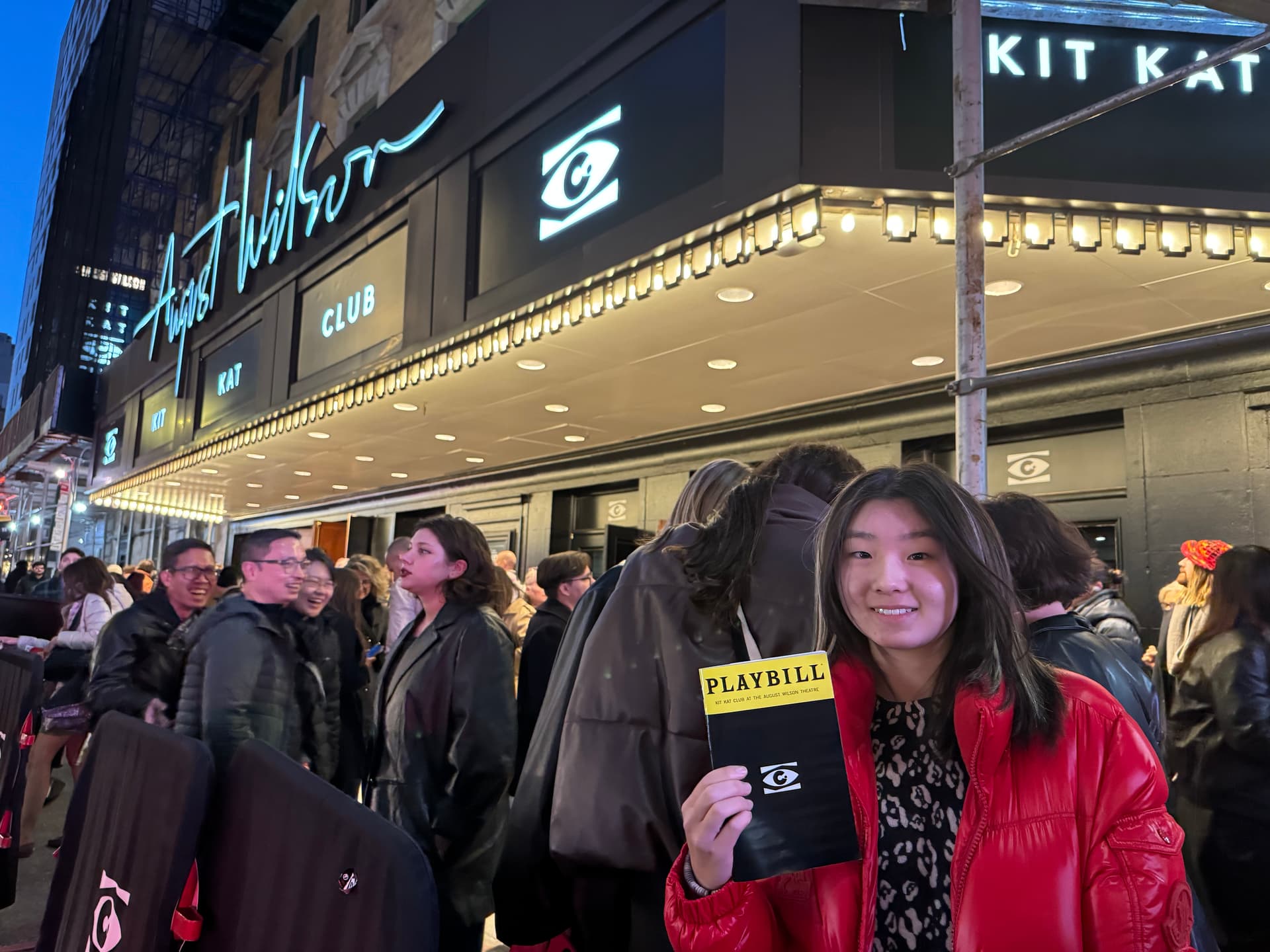
2024: The Kit Kat Club Becomes an Entire World Rebecca Frecknall's production, which had originated in London, arrived on Broadway in 2024 as Cabaret at the Kit Kat Club. The August Wilson Theatre underwent an enormous transformation. Audiences entered through redesigned spaces rather than simply walking into a conventional Broadway auditorium. The production incorporated pre-show performers, bars, music, dancing, and environmental design, turning arrival itself into part of the performance. The original Broadway cast featured Eddie Redmayne as the Emcee, Gayle Rankin as Sally Bowles, Bebe Neuwirth as Fräulein Schneider, and Steven Skybell as Herr Schultz. The production received nine Tony nominations and won Best Scenic Design of a Musical for Tom Scutt. (IBDB)
The transformation of the theater was not decorative. It was the revival's central argument.
Seducing the Audience
The 2024 production understands that the Kit Kat Klub must initially feel desirable. Before the musical properly begins, audiences encounter performers throughout the building. The atmosphere suggests freedom. Normal rules appear suspended. The audience is not being shown decadence from a historical distance. They are being invited to consume it. That matters because the musical's political warning becomes much more uncomfortable if we first enjoy the escape. The audience understands why Sally wants to remain. The club is fun. It is strange. It is beautiful. It seems separate from everything happening outside. Until it isn't.
Eddie Redmayne's Emcee
Eddie Redmayne offered another radical reinterpretation of the Emcee. Rather than reproducing Cumming's seductive, sexually charged figure, Redmayne created something more alien, angular, and puppet-like. His body could appear distorted.
His movements could feel controlled and artificial. His costumes repeatedly transformed his identity. The result emphasized the Emcee less as a realistic nightclub host than as an embodiment of the changing world surrounding the characters. That distinction demonstrates how the same role can carry fundamentally different meanings. Grey's Emcee. Cumming's Emcee. Redmayne's Emcee. None cancels the others. Each becomes a historical record of what a particular generation saw inside the character.
The Club Changes with the Politics
One of the most disturbing ideas in Frecknall's production is the gradual transformation of the theatrical environment. At first, the Kit Kat Club celebrates difference. Individuality is everywhere. Bodies, costumes, identities, and performances resist uniformity. But as fascism gains power, the visual world begins to change. Difference gives way to conformity. The theatrical language itself becomes more controlled. That makes authoritarianism visible not only through dialogue or Nazi symbols but through aesthetics. The question becomes: What happens to a society when difference itself becomes dangerous? The production turns design into political storytelling.
Sally Bowles and Denial
Gayle Rankin's Sally exists within this increasingly unstable world. Sally has always been one of musical theater's great characters of denial. She does not fail to notice everything happening around her. She chooses which realities she is willing to acknowledge. That distinction is crucial. Sally's insistence on staying in Berlin is not simply ignorance. It is a philosophy: keep performing, keep drinking, keep moving, and perhaps reality can be held outside the door. But Cabaret knows that doors do not stop history. Eventually, political reality enters every room.
Schneider and Schultz: The Story Outside the Cabaret
The relationship between Fräulein Schneider and Herr Schultz provides the musical's most devastating contrast with Sally's world. Their romance is quieter. Older. Less glamorous. But when Schneider realizes what marrying a Jewish man may mean under the changing political conditions, fear overwhelms affection. In the 2024 production, Bebe Neuwirth and Steven Skybell gave this storyline particular emotional weight; both received Tony nominations. (IBDB) Their relationship reveals something the Kit Kat Club tries to conceal. Politics is not abstract.
Political change eventually determines:
who can marry, who can work, who belongs, who is safe, and eventually who is permitted to survive.
Three Revivals, Three Different Questions
Taken together, the three productions create an extraordinary case study in what revival means. Revival Central Reinterpretation Question 1998 The audience enters the Kit Kat Klub What if we are not observing the decadence, but participating in it? 2014 A landmark revival itself is revived Can a radical interpretation become part of the canon? 2024 The entire theater becomes an immersive club that gradually transforms How easily can pleasure and distraction prevent us from recognizing political danger? The differences matter more than determining which production is “best.” Together, they reveal that Cabaret is not a fixed object. It is a conversation between 1930s Berlin, 1966 Broadway, 1998 Broadway, 2014 Broadway, 2024 Broadway, and every audience sitting inside the theater.
Historical Reevaluation
Cabaret also demonstrates why certain musicals attract repeated reinterpretation. The central historical events do not change. The Weimar Republic still collapses. Nazism still rises. Antisemitism still intensifies. Schneider still confronts the consequences of marrying Schultz. Sally still wants to remain inside her fantasy. But every generation arrives with different experiences of authoritarianism, prejudice, sexuality, gender, political polarization, and the relationship between entertainment and reality. That changes which parts of Cabaret feel most urgent. The musical becomes a kind of theatrical mirror. The reflection changes because the audience standing in front of it changes.
Why These Revivals Changed Broadway
The history of Cabaret challenges the idea that there is one definitive production of a great musical. The 1998 revival demonstrated that immersive staging could fundamentally change the audience's moral relationship to a classic. The 2014 revival demonstrated that an interpretation can itself become historically important enough to revive. The 2024 production pushed immersion even further, transforming the Broadway theater into an environment audiences inhabit before the conventional performance even begins. Its scenic transformation earned Tom Scutt the 2024 Tony for Best Scenic Design of a Musical. (IBDB) More importantly, each production understands that Cabaret cannot simply be about what happened in Germany. It must eventually make the audience wonder about the room they are sitting in now. That may be the reason directors keep returning to it.
Why It Resonates With Me
What fascinates me most about these three Cabaret revivals is that they show how reinterpretation itself becomes history. The 1998 production was radical because it refused to let audiences sit comfortably outside the Kit Kat Klub. By 2014, that once-radical staging had become important enough to preserve. Then the 2024 production had to find another way to destabilize audiences, surrounding them with an even more seductive theatrical world before allowing that world to become frightening. For me, Cabaret may be one of the clearest examples of why revivals matter. The danger in the story never changes—but every generation has to decide where it sees itself inside that story. A great revival does not simply ask us to look again at the past. It changes the mirror until we can see ourselves.