Overview
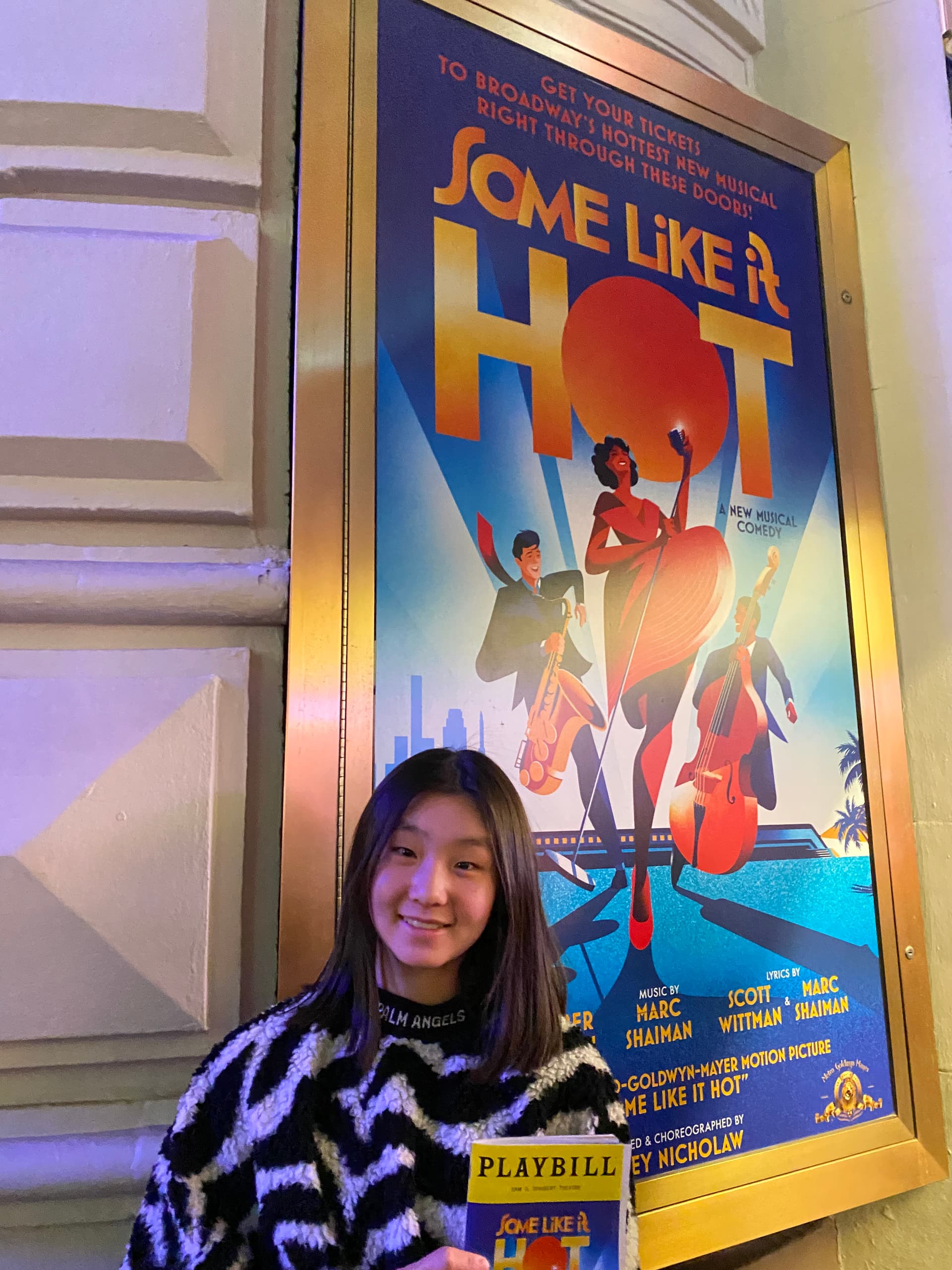
When Some Like It Hot opened at the Shubert Theatre on December 11, 2022, it faced a challenge common to contemporary Broadway: how do you adapt a beloved work from another era without simply reproducing the assumptions of the era that created it?
Based on Billy Wilder's 1959 film, the musical begins in Prohibition-era Chicago in 1933. Musicians Joe and Jerry accidentally witness a mob killing and must escape before the gangsters find them. Their solution is to disguise themselves as women—Josephine and Daphne—and join an all-female touring band heading west. There they meet Sugar, the band's ambitious singer, who dreams of escaping the limitations placed on Black performers and becoming a Hollywood star. Joe initially treats his female identity as a disguise that will help him survive and get closer to Sugar. Jerry's experience becomes something entirely different. As Daphne, Jerry discovers an identity that feels increasingly authentic rather than temporary. What begins as a familiar cross-dressing farce gradually becomes a story about gender, self-discovery, race, performance, and the freedom to become someone you did not previously know you could be. Songs including “What Are You Thirsty For?,” “You Can't Have Me (If You Don't Have Him),” “A Darker Shade of Blue,” “You Coulda Knocked Me Over with a Feather,” and “Tip Tap Trouble” combine big-band jazz, swing, tap, and classic Broadway musical comedy with a distinctly contemporary understanding of identity.
Historical Era
The musical is set during the Great Depression and Prohibition, but it deliberately evokes the Hollywood and Broadway entertainment traditions of the 1930s. Big bands, nightclubs, touring orchestras, tap dancing, glamorous costumes, and Art Deco design create the feeling of an enormous Golden Age musical comedy. That choice creates a productive contradiction. Some Like It Hot looks backward stylistically while thinking forward culturally. Its music recalls an earlier Broadway vocabulary, while its book asks questions about gender and race that the original 1959 film approached very differently. The production therefore does not attempt to pretend it was written in 1933. It asks what contemporary Broadway can do with the theatrical language of 1933. From Billy Wilder to Broadway Billy Wilder's Some Like It Hot, starring Marilyn Monroe, Tony Curtis, and Jack Lemmon, is considered one of the landmark American film comedies. Its central mechanism is disguise.
Joe and Jerry become women because gangsters are trying to kill them, producing a series of romantic and comic complications. The film's famous final exchange—ending with the observation that “nobody's perfect”—allowed gender and sexuality to remain playfully unresolved in a way that was unusually suggestive for mainstream American cinema in 1959. But a stage adaptation created decades later could not simply repeat the same joke. Matthew López and Amber Ruffin therefore fundamentally reconceived Jerry's story. Daphne is no longer only a costume. She becomes a discovery. That change turns adaptation into reinterpretation rather than replication. Daphne and Identity The musical's most important transformation belongs to Jerry/Daphne. At first, Jerry believes Daphne exists only because the disguise is necessary. But the longer Daphne exists, the more complicated that assumption becomes. In “You Coulda Knocked Me Over with a Feather,” Daphne recognizes that this identity has revealed something real. The musical does not frame that realization as humiliation or a punchline. Instead, it allows Daphne to experience joy. This radically changes the function of the original story's cross-dressing comedy. The audience may initially understand the disguise through familiar farce conventions. Gradually, the musical asks us to recognize that performance can sometimes reveal identity rather than conceal it. That idea makes Some Like It Hot particularly appropriate for theater, an art form built around people discovering truths while pretending to be someone else. Race and the Entertainment Industry The Broadway adaptation also changes Sugar.
In the film, Marilyn Monroe's Sugar is primarily trying to escape unsuccessful relationships and find a wealthy husband. The musical's Sugar, originated by Adrianna Hicks, is a Black performer dreaming of becoming a Hollywood star. That changes the historical stakes of her ambition. In 1933, Black performers faced substantial racial discrimination in American entertainment, including segregation, restricted roles, and stereotypes that limited how they could appear onstage and onscreen. Sugar's dream is therefore not simply celebrity. She wants access to an industry whose structures were not designed to give someone like her equal opportunity. Her ambition makes the musical's larger theme of reinvention extend beyond gender. Joe, Daphne, and Sugar are all attempting to imagine lives beyond the identities and opportunities society has assigned them.
Production Innovation
Some Like It Hot embraces one of the oldest Broadway technologies imaginable: dance. Casey Nicholaw's choreography draws heavily from tap and classic musical comedy while using contemporary staging speed and precision. Rather than treating Golden Age choreography as something to reproduce nostalgically, the production makes it feel almost athletic. The show's climactic “Tip Tap Trouble” sequence is especially remarkable. Gangsters pursue Joe and Daphne through a hotel while doors open and close, performers disappear and reappear, identities change, and the chase unfolds largely through choreography. Farce becomes dance. Dance becomes action. The sequence demonstrates that choreography can perform the function usually assigned to cinematic editing: controlling what the audience sees, when they see it, and how quickly information changes. The Hotel Chase
The hotel sequence is one of the clearest examples of why this story works differently onstage than onscreen. Film can cut instantly between rooms. Theater cannot. Instead, the production turns that limitation into an advantage. Doors, corridors, bodies, costume changes, and tap rhythms create a precisely coordinated machine. The audience understands that everything is happening live. That knowledge increases the tension and excitement because one missed entrance or mistimed movement could disrupt the entire sequence. Like the best Broadway spectacle, the thrill comes partly from watching human beings accomplish something extraordinarily difficult in real time. Representation and Reinvention Some Like It Hot belongs to a larger twenty-first-century Broadway conversation about how older works should be revived and adapted. One approach is preservation: reproduce the original as faithfully as possible. Another is reinvention. This musical clearly chooses reinvention. The creative team retains the central mechanism, period setting, gangster comedy, and musical-comedy energy of the film while reconsidering whose stories can exist inside that framework. That raises a broader question relevant throughout Broadway history: When does changing an older work betray it, and when does changing it allow the work to remain alive? Some Like It Hot argues strongly for the second possibility.
Historical Significance
At the 2023 Tony Awards, Some Like It Hot led the season with 13 nominations and won four awards. J. Harrison Ghee, who originated Jerry/Daphne, won the Tony Award for Best Leading Actor in a Musical, becoming, alongside Shucked performer Alex Newell that same evening, one of the first openly nonbinary performers to win an acting Tony Award.
Casey Nicholaw won Best Choreography, while the production also received awards for Best Orchestrations and Best Costume Design of a Musical. The show therefore became historically significant not only for what it represented onstage but for the changing identities of the artists Broadway was recognizing at its highest level. Its Broadway run ended in December 2023, but its significance extends beyond its relatively short run. Broadway Looking Backward to Move Forward Some Like It Hot occupies an interesting place in this exhibition because it deliberately resembles Broadway's past. Its brass-heavy score, enormous tap sequences, glamorous costumes, romantic comedy, and fast-moving farce could easily belong to an earlier era. Yet the people placed at the center of that form are different. That combination matters. Broadway history does not necessarily advance by abandoning older theatrical traditions. Sometimes innovation comes from asking who was previously excluded from those traditions and what happens when they are finally allowed to occupy the center of them. The musical therefore treats Broadway's past not as a museum object but as material that can be rearranged.
Why It Resonates With Me
What I find most interesting about Some Like It Hot is the idea that performance can help someone discover rather than hide who they are. Jerry initially becomes Daphne because the situation requires a costume, but that act of pretending unexpectedly creates space for something genuine to emerge. That feels especially appropriate for theater, where performers constantly use fictional identities to reveal real emotions and ideas. I also love that the production does not reject traditional Broadway in order to become contemporary. It keeps the tap dancing, big band, comedy, costumes, and enormous production numbers while changing who gets to occupy those forms. For me, Some Like It Hot demonstrates that keeping Broadway history alive does not require freezing it. Sometimes honoring a tradition means giving new people the freedom to transform it.