Overview
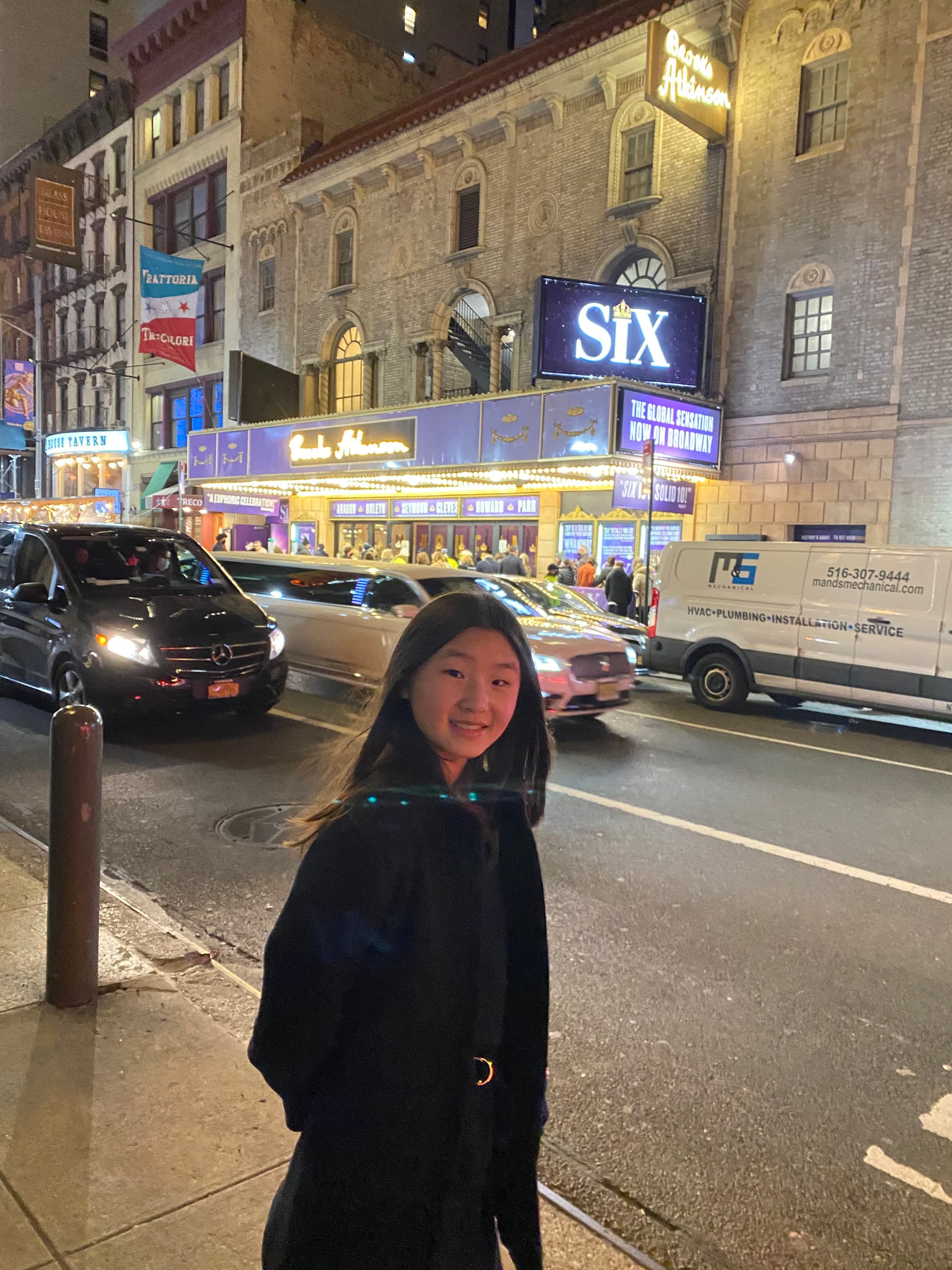
When SIX officially opened at the Brooks Atkinson Theatre on October 3, 2021, it turned six women usually remembered through one man's biography into the stars of their own pop concert. The premise is deliberately simple: the six wives of Henry VIII—Catherine of Aragon, Anne Boleyn, Jane Seymour, Anna of Cleves, Katherine Howard, and Catherine Parr—have formed a girl group. Each competes to become its lead singer by proving that she suffered the most because of Henry. The familiar mnemonic— “Divorced, beheaded, died; divorced, beheaded, survived” —becomes the structure the musical sets out to dismantle. Each queen performs a solo influenced by contemporary pop stars, transforming Tudor history into the language of Beyoncé, Adele, Ariana Grande, Rihanna, Nicki Minaj, and other modern performers. Songs including “Ex-Wives,” “No Way,” “Don’t Lose Ur Head,” “Heart of Stone,” “Get Down,” “All You Wanna Do,” and “I Don’t Need Your Love” gradually reveal the limitation of the competition itself. Why should these women have to define themselves according to what Henry did to them at all? The musical's central act of revision is therefore not deciding which wife had the worst husband. It is allowing all six women to imagine identities beyond being his wives.
Historical Era
SIX began far from Broadway. Toby Marlow and Lucy Moss developed the musical while students at Cambridge University, initially creating it for the 2017 Edinburgh Festival Fringe. Its development reflects a very different pathway from the traditional Broadway musical. Rather than beginning with established Broadway producers, it grew from a student production into a professional British phenomenon, transferred to London's West End, toured internationally, and eventually reached Broadway. The show's Broadway opening also became historically unusual.
SIX had been scheduled to officially open on March 12, 2020. That was the day Broadway shut down because of the COVID-19 pandemic. After eighteen months of closure, the production resumed performances in September 2021 and finally celebrated its official Broadway opening on October 3. As a result, SIX became closely associated with Broadway's emergence from the pandemic shutdown.
Historical & Cultural Context
Henry VIII's wives have been remembered for centuries largely according to their relationships with the king. Even the famous mnemonic reduces six complicated lives to six outcomes determined by one man. SIX begins with that familiar framework and then deliberately exposes its limitations. Catherine of Aragon emphasizes her political status and refuses to accept Henry's attempt to replace her. Anne Boleyn turns centuries of scandal surrounding her into deliberately chaotic comedy. Jane Seymour, often remembered primarily as the wife Henry supposedly loved most, asks what it means to have her identity defined by devotion to him. Anna of Cleves discovers unexpected independence after Henry rejects her. Katherine Howard's apparently playful pop persona gradually reveals a disturbing history of sexual exploitation. And Catherine Parr ultimately questions the entire premise of defining these women according to their husband. The show does not claim to be a history lecture. It uses historical reinterpretation to ask why certain versions of people become easier to remember than others. Pop Music as Historical Language Like Hamilton, SIX uses deliberately anachronistic music to collapse the distance between historical figures and contemporary audiences. But where Hamilton uses hip-hop and musical-theatre storytelling to dramatize political history, SIX is structured primarily as a pop concert. Each queen's musical identity draws inspiration from different contemporary performers.
Catherine of Aragon's sound evokes powerhouse pop and R&B singers such as Beyoncé and Jennifer Lopez. Anne Boleyn channels the rebellious energy of artists such as Avril Lavigne and Lily Allen. Jane Seymour's ballad recalls singers such as Adele. Anna of Cleves performs in a confident electronic style, while Katherine Howard's number uses the language of hyper-produced contemporary pop. The musical styles become forms of characterization. Historical research provides the material. Pop culture provides the vocabulary. “All You Wanna Do” One of the musical's most effective structural reversals occurs in Katherine Howard's “All You Wanna Do.” The song begins like an energetic contemporary pop number. Howard describes a series of relationships with older men, initially framing each encounter with the language of flirtation and romance. But the pattern repeats. As the song continues, the choreography, performance, and repeated musical structure become increasingly uncomfortable. What initially sounded playful begins to reveal a history of exploitation and unequal power. The audience's response changes while the song is still happening. That transformation demonstrates one of SIX's strongest theatrical techniques: using the familiar pleasures of pop music and then forcing audiences to reconsider what they have been enjoying.
Production Innovation
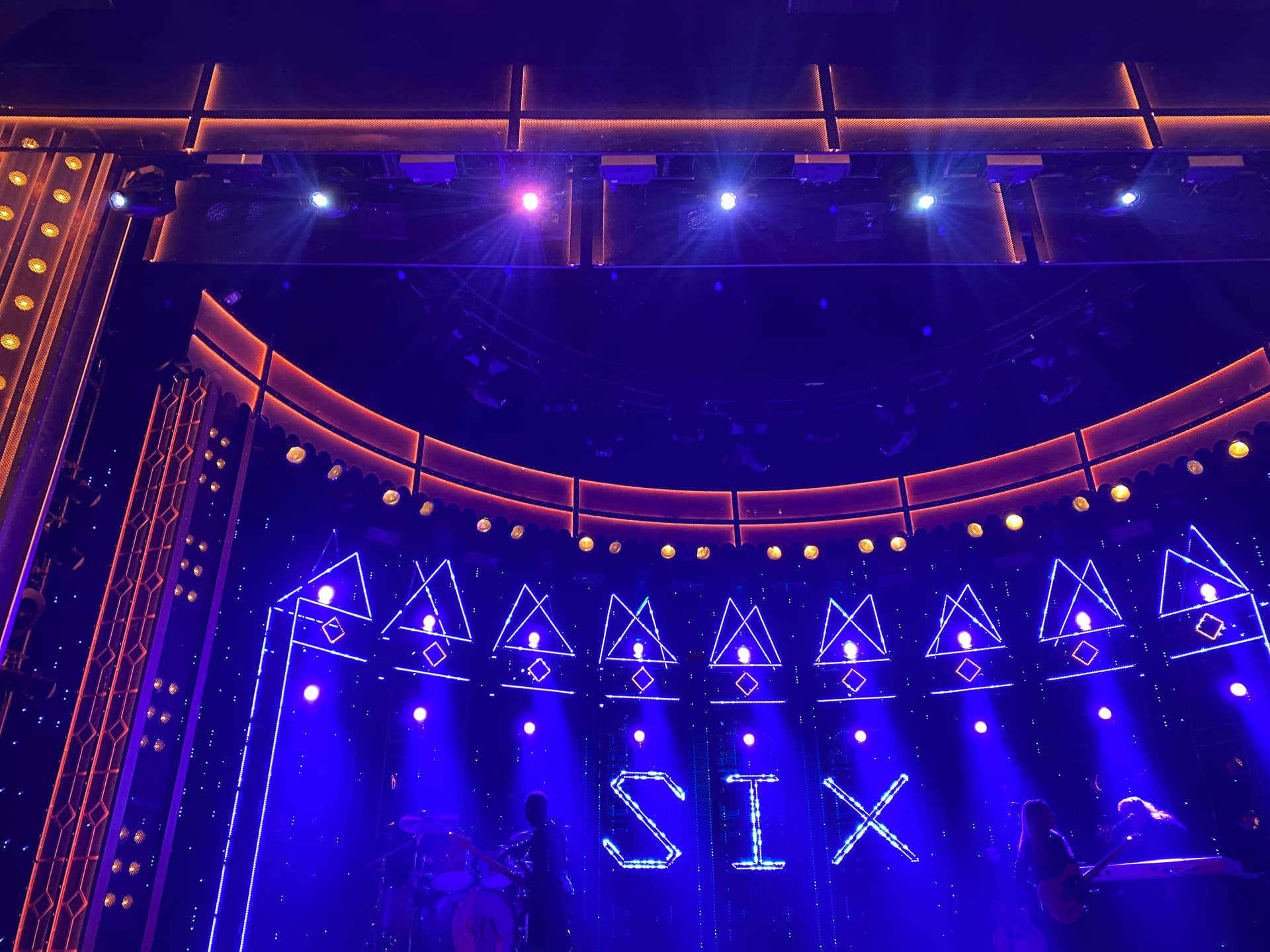
SIX radically reduces the machinery traditionally associated with the historical musical. There are no realistic Tudor palaces. No elaborate changes of location. No attempt to recreate sixteenth-century England. Instead, the stage resembles a contemporary arena concert, complete with lighting rigs, microphones, costumes inspired by both Tudor silhouettes and modern pop fashion, and an all-female onstage band known as the Ladies in Waiting.
The queens address the audience directly. They compete for applause. The audience becomes the fictional concert crowd responsible for choosing the group's lead singer. That makes spectators participants in the musical's initial logic. We are encouraged to compare the women's suffering. Then the show asks us to recognize why that competition is problematic. Rewriting Historical Women The most important turning point comes with Catherine Parr. Unlike the other queens, Parr initially resists reducing her life to her relationship with Henry. Before marrying him, she had intellectual ambitions, relationships, and a history of her own. Her song “I Don’t Need Your Love” shifts the musical away from the competition. The queens begin asking what their lives might look like if history had not organized them around Henry VIII. The finale therefore creates deliberately fictional alternative futures. The show does not pretend these imagined lives are historically accurate. That is precisely the point. The historical record cannot be rewritten. But the framework through which audiences remember these women can be challenged.
Historical Significance
SIX became one of the most distinctive musical-theatre successes of its generation. At the 2022 Tony Awards, Toby Marlow and Lucy Moss won Best Original Score, while Gabriella Slade won Best Costume Design of a Musical. Marlow and Moss's win was especially notable because they had begun creating the musical as university students only a few years earlier. The production also became particularly successful with younger audiences, aided by streaming, social media, fan culture, concert-style performances, and a cast recording that could circulate independently of the stage production.
In that respect, SIX reflects a major change in how twenty-first-century Broadway musicals build audiences. A musical no longer exists only inside its theater. Its songs, performers, costumes, choreography, fan art, clips, and interpretations can circulate continuously through digital culture. SIX and Hamilton The comparison with Hamilton is unavoidable—and useful. Both musicals take figures from political history and give them contemporary musical languages. Both deliberately reject historical realism. Both ask who controls historical memory. But they approach those questions differently. Hamilton reconstructs a large historical narrative and places people of color inside roles traditionally associated with white Founding Fathers. SIX does almost the opposite structurally. It strips history down to six women, six microphones, and their competing accounts of themselves. Where Hamilton asks “Who tells your story?”, SIX asks what happens when the people whose stories have been reduced to supporting roles finally get microphones of their own.
Why It Resonates With Me
What I find most compelling about SIX is how directly it challenges the way history gets organized. I learned the wives of Henry VIII through the same mnemonic the musical begins with—“divorced, beheaded, died”—which is useful for remembering facts but terrible for remembering people. SIX exposes how much can disappear when someone's entire life becomes a label attached to somebody more powerful. I also love its use of contemporary pop music because it does not try to pretend we can experience the Tudor world exactly as people did in the sixteenth century. Instead, it asks how our own cultural language can make us reconsider whose perspective historical narratives have privileged. For me, SIX belongs naturally beside Hamilton in this exhibition: both demonstrate that revisiting history is not only about discovering new facts. Sometimes it means changing who gets the microphone.