Overview
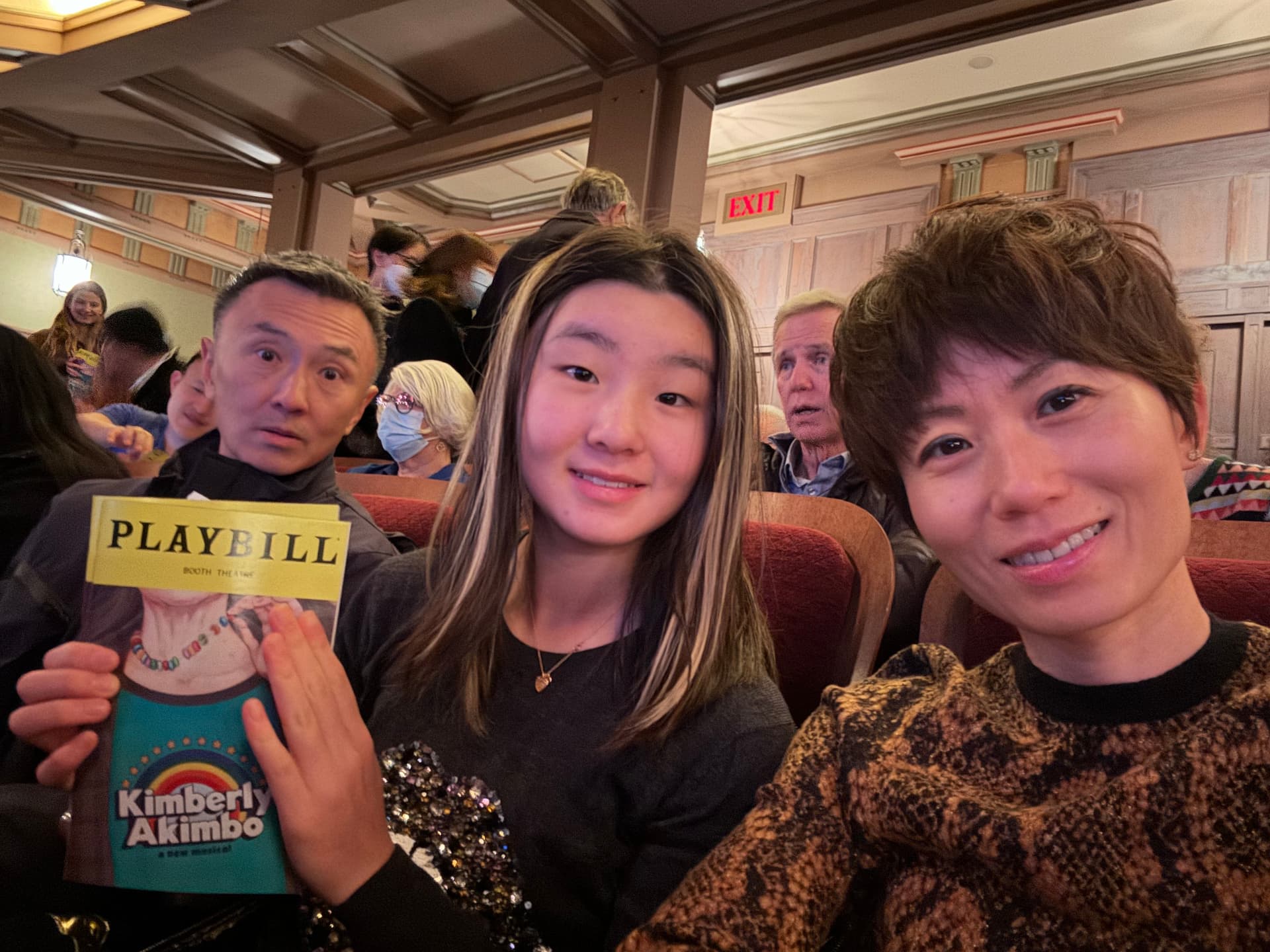
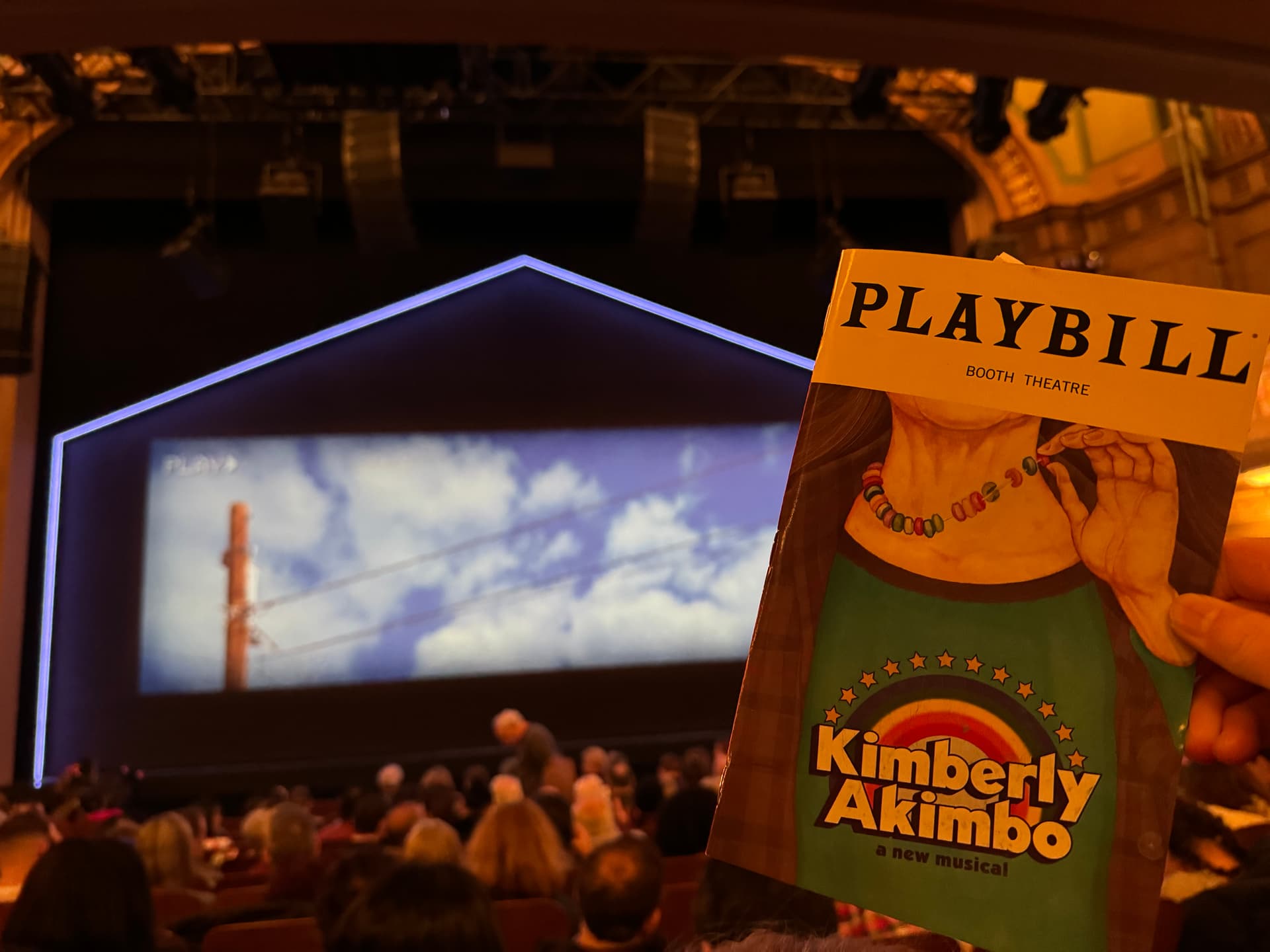
When Kimberly Akimbo opened at the Booth Theatre on November 10, 2022, it offered a striking alternative to the spectacle and familiar intellectual property dominating much of contemporary Broadway. Its protagonist is a teenage girl confronting an extraordinary circumstance, but the musical is ultimately concerned with something universal: how do you live when you know that time is limited? Kimberly Levaco is about to turn sixteen. She has recently moved with her dysfunctional family to suburban New Jersey and wants many of the things other teenagers want: friendship, romance, independence, and a life that feels larger than high school. But Kimberly has a rare genetic condition that causes her body to age several times faster than usual. Although she is sixteen, she appears to be an elderly woman, and her expected lifespan is short. Her family provides little stability. Her father, Buddy, struggles with alcohol and repeatedly disappoints her. Her pregnant mother, Pattie, is absorbed in her own problems. Her eccentric Aunt Debra reappears with a criminal scheme involving stolen checks. Then Kimberly meets Seth, an awkward classmate fascinated by anagrams. Their friendship gradually becomes something deeper. Songs including “Make a Wish,” “Anagram,” “Better,” “Father Time,” “Before I Go,” and “Great Adventure” combine absurd comedy with an awareness of mortality. The musical’s question is not whether Kimberly can stop time. She cannot. It is whether knowing that life is temporary should make us more afraid to live—or more determined to do it.
Historical Era
Kimberly Akimbo arrived on Broadway during the theater’s difficult emergence from the COVID-19 pandemic. Broadway had shut down for approximately eighteen months beginning in March 2020. When theaters reopened, the industry faced changed audience habits, financial uncertainty, rising production costs, and questions about what kinds of shows could survive commercially. Against that environment, Kimberly Akimbo was unusually modest. It had no famous movie franchise behind it, no enormous ensemble, and no spectacle-driven marketing concept. Before Broadway, it premiered at the Atlantic Theater Company Off-Broadway in 2021. Its eventual success became an important reminder that contemporary Broadway could still make room for a small, original, character-driven musical. From Play to Musical David Lindsay-Abaire originally wrote Kimberly Akimbo as a play, first produced in 2001. Two decades later, he returned to the story with composer Jeanine Tesori. The transformation into a musical is significant because Kimberly’s situation contains a contradiction that music can express especially well. Her physical appearance suggests old age. Her emotional life is unmistakably adolescent. She wants her first kiss. She worries about classmates. She argues with her parents. She dreams about getting out of her town. Music allows the audience to hear the teenager that strangers may fail to see. The adaptation therefore demonstrates why musicalizing an existing story can do more than simply add songs. The score gives Kimberly an interior age that conflicts with the age other people assume from her body. Adolescence and Mortality Most coming-of-age stories assume their characters have enormous amounts of time ahead of them. Kimberly does not. That changes the meaning of ordinary teenage milestones.
A birthday is not simply another birthday. A first relationship might also be one of the only relationships she gets to experience. Waiting until adulthood to begin living may not be an option. Yet the musical refuses to make Kimberly simply an object of tragedy. She is funny, impatient, intelligent, occasionally reckless, and capable of making questionable choices. Her medical condition shapes her life without becoming her entire personality. That distinction is central to the show's emotional power. Kimberly does not spend the musical simply dying. She spends it trying to live. Family Dysfunction and Dark Comedy The Levacos are one of the musical's strangest achievements. Kimberly's parents clearly love her, yet they repeatedly fail her. Buddy promises things he does not deliver. Pattie can become so absorbed in her own difficulties that Kimberly's needs disappear from view. Then there is Aunt Debra. Debra recruits Kimberly and her classmates into a ridiculous check-fraud operation, introducing something close to a crime comedy into what might otherwise have become a sentimental drama. That tonal collision is deliberate. The musical continually places sadness beside absurdity. A terrible family moment can become funny. A comic scene can suddenly reveal something painful. The result resembles life more closely than a story that separates tragedy and comedy neatly from one another.
Production Innovation
Unlike many twenty-first-century Broadway musicals, Kimberly Akimbo does not depend upon technological spectacle.
Its innovation is primarily dramaturgical and performative. The production asks an adult performer to play a sixteen-year-old without treating Kimberly as a joke. Victoria Clark, who originated the Broadway role, does not attempt to disguise herself as a literal teenager. Instead, she communicates adolescence through posture, energy, hesitation, excitement, and emotional vulnerability. The audience understands the contradiction immediately: we see an older woman while gradually learning to perceive Kimberly as sixteen. That requires the audience to participate imaginatively. In that sense, the musical uses one of theater's oldest technologies—the performer's body—to create its central illusion. “Anagram” and Seeing Differently Seth's obsession with anagrams becomes one of the musical's most effective metaphors. An anagram takes the same letters and rearranges them to reveal something unexpected. Nothing has been added. Nothing has been removed. The perspective has changed. That is also what Seth does with Kimberly. Other people see her appearance and make assumptions about who she must be. Seth gradually sees the person underneath those assumptions. The metaphor extends to the entire musical. Kimberly cannot replace the circumstances of her life. But she can rearrange what she does with the time she has. “Great Adventure” The musical's philosophy becomes clearest in “Great Adventure.”
Kimberly eventually recognizes that she cannot wait for her parents to become the family she wishes they were. She cannot wait for her medical condition to disappear. She cannot wait until some future moment when everything becomes safe. Instead, she chooses experience. That decision is not presented as denial. Kimberly understands the reality of her situation perhaps better than anyone around her. Her optimism therefore carries unusual weight. She does not believe everything will work out. She decides that uncertainty is not a sufficient reason to stop living.
Historical Significance
At the 2023 Tony Awards, Kimberly Akimbo received eight nominations and won five awards, including Best Musical, Best Book of a Musical, Best Original Score, Best Actress in a Musical for Victoria Clark, and Best Featured Actress for Bonnie Milligan as Debra. Jeanine Tesori's victory added another important work to a career that already included Caroline, or Change, Shrek the Musical, and Fun Home. The success of Kimberly Akimbo was particularly significant because it was not built around spectacle or a globally recognizable entertainment franchise. Its central character was played by a woman in her sixties portraying a sixteen-year-old girl. Its story mixed terminal illness, teenage romance, family dysfunction, show choir, anagrams, and check fraud. Nothing about it looked like an obvious formula for a Best Musical winner. That was precisely why its success mattered. A Different Kind of Broadway Scale Broadway history is often told through expansion. Bigger orchestras. Bigger theaters.
More elaborate scenery. More advanced technology. Shows such as The Phantom of the Opera, The Lion King, Wicked, and Hamilton demonstrate different forms of theatrical scale. Kimberly Akimbo offers another possibility. Emotional scale does not have to correspond to physical scale. A teenager sitting at a skating rink can carry enormous dramatic weight. An anagram can become a theatrical metaphor. A small family story can ask one of the oldest questions in human culture: what should we do with the limited amount of time we are given? That makes Kimberly Akimbo an important work for understanding the continued diversity of twenty-first-century Broadway.
Why It Resonates With Me
What I find most moving about Kimberly Akimbo is that it does not tell Kimberly to stop thinking about time. She knows better than anyone that time matters. Instead, the musical changes the question from “How much time do I have?” to “What am I going to do with it?” I also love the anagram metaphor: the letters stay exactly the same, but rearranging them can reveal something you could not see before. That feels like a powerful way of thinking about life more broadly. We cannot always choose the circumstances we are given, but we can still decide how we arrange our attention, relationships, ambitions, and experiences within them. Kimberly’s great adventure matters not because it will last forever, but because she chooses to have it at all.