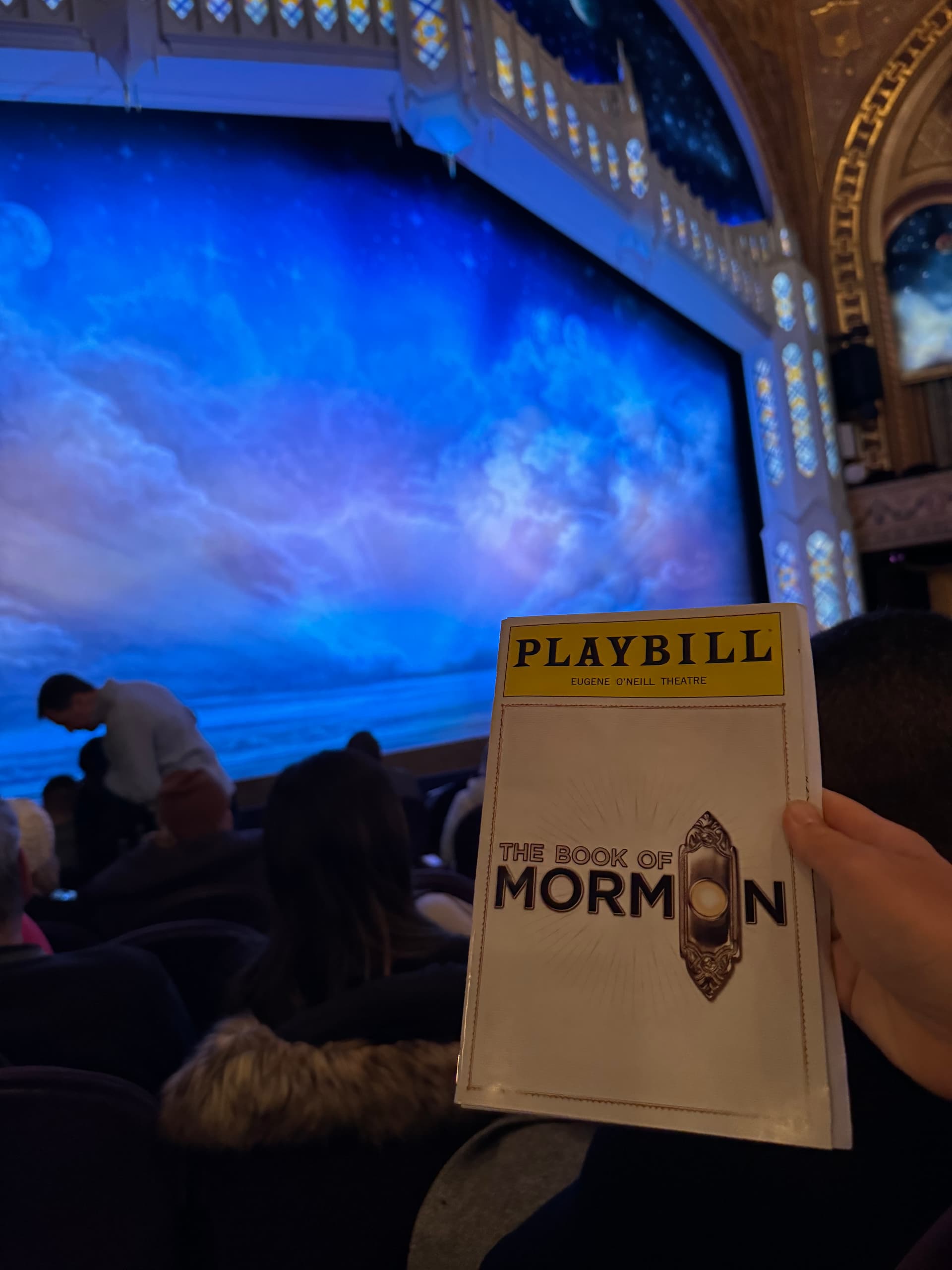
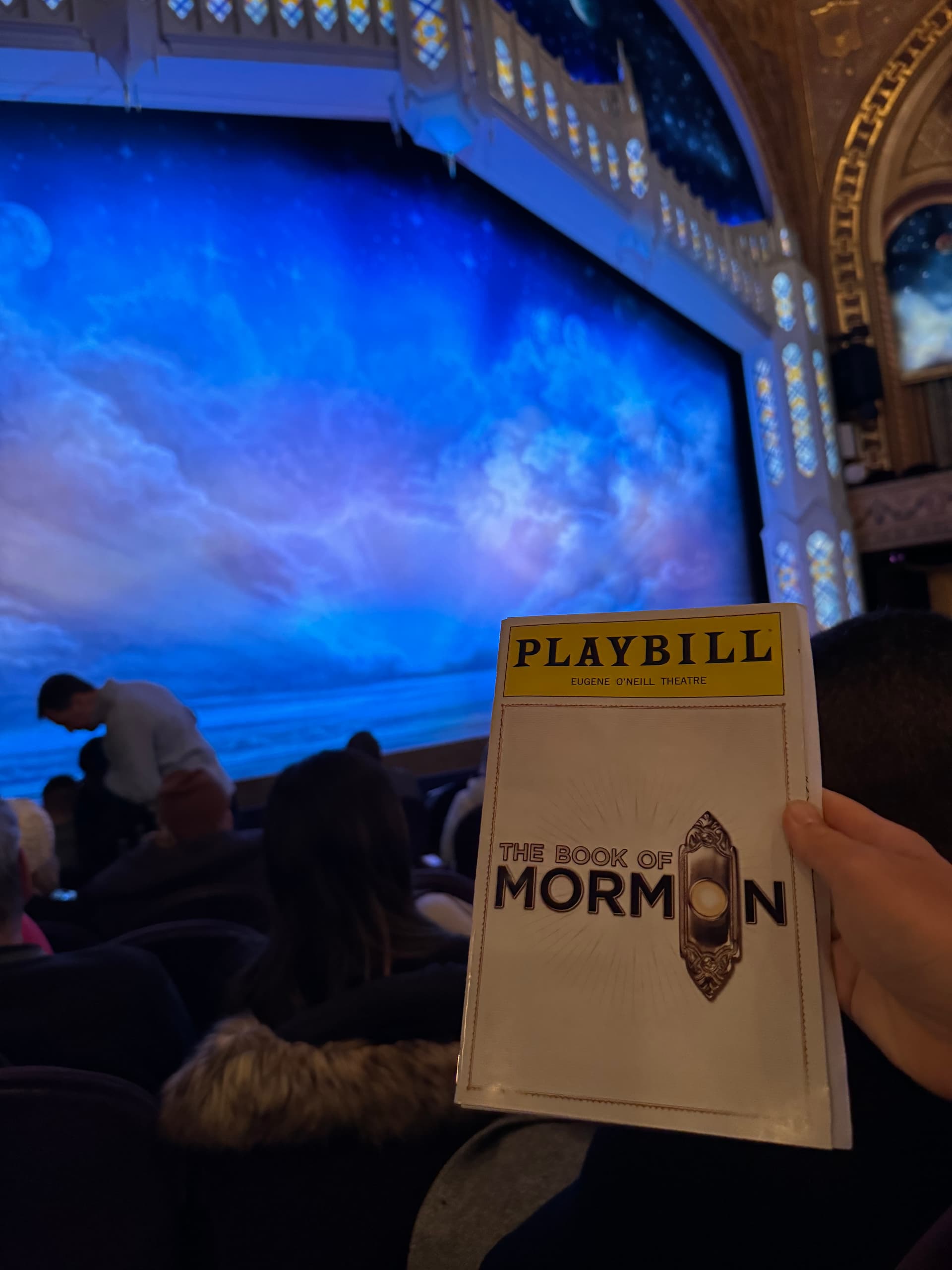
Overview
When The Book of Mormon opened at the Eugene O’Neill Theatre on March 24, 2011, it combined the structure of an exuberant, old-fashioned Broadway musical with the deliberately provocative comedy of South Park. The result was a show that simultaneously celebrates the mechanics of musical theatre and satirizes religion, missionary culture, American optimism, and the desire to impose simple answers on complicated problems. The musical follows two young missionaries from the Church of Jesus Christ of Latter-day Saints. Elder Kevin Price is confident, ambitious, and convinced that his faith and talent will earn him a glamorous mission assignment. Instead, he is paired with Elder Arnold Cunningham, an insecure and compulsively dishonest missionary, and sent to Uganda. The missionaries arrive expecting to change people's lives through faith. Instead, they encounter a community facing poverty, disease, violence, and other problems for which their rehearsed religious lessons offer no immediate solution. Price experiences a crisis of faith, while Cunningham begins inventing increasingly absurd versions of scripture to make his teachings relevant to the villagers. Unexpectedly, his stories begin attracting converts. Songs including “Hello!,” “You and Me (But Mostly Me),” “Hasa Diga Eebowai,” “Turn It Off,” “Man Up,” “I Believe,” and “Tomorrow Is a Latter Day” use Broadway's most cheerful musical vocabulary to ask a much less comfortable question: when does belief help people—and when does believing you have the answer prevent you from listening to them?
Historical Era
The Book of Mormon arrived on Broadway in 2011, when musical comedy was thriving alongside large franchise productions and film adaptations. Shows such as The Producers, Hairspray, Avenue Q, and Spamalot had demonstrated that audiences were receptive to musicals that were self-aware, irreverent, and willing to parody Broadway conventions. The Book of Mormon emerged directly from that tradition.
Robert Lopez had co-created Avenue Q, while Trey Parker and Matt Stone had spent years using animation, songs, satire, and deliberately offensive humor on South Park. Their collaboration joined two comic traditions: Broadway parody and boundary-pushing television satire. But the show is not anti-musical-theatre. Quite the opposite. Its comedy depends on an unusually sophisticated understanding of how Broadway works.
Historical & Cultural Context
The musical draws heavily on the missionary tradition of the Church of Jesus Christ of Latter-day Saints, whose young members may volunteer for full-time missionary service around the world. Price begins the story with absolute confidence in the system. He expects that if he follows the prescribed rules, he will be rewarded. His dream assignment is Orlando. Uganda destroys that expectation. The missionaries discover that repeating familiar teachings does not automatically make those teachings meaningful to people whose experiences are radically different from their own. That cultural collision allows the musical to satirize a broader tendency extending beyond Mormonism: the belief that outsiders can enter an unfamiliar community and immediately understand what that community needs. Faith, Storytelling, and Belief Despite its aggressive religious satire, The Book of Mormon develops a surprisingly complicated argument about belief. Cunningham is objectively terrible at accurately communicating scripture. He combines religious stories with material drawn from science fiction and popular culture. Yet the Ugandan villagers begin finding meaning in what he tells them. The musical gradually shifts the question from whether a story is literally correct to what people do with the story once they believe it. By the ending, the villagers have not simply accepted Cunningham's teachings passively. They reinterpret them according to their own experiences. That transformation complicates the missionaries' original assumption that religious knowledge moves in one direction—from missionary to convert.
Instead, meaning is created through adaptation.
Production Innovation
The show's most distinctive theatrical technique is the contrast between traditional Broadway form and extremely unconventional content. “Hello!” resembles an impeccably constructed musical-comedy opening number. Missionaries ring doorbells in perfect synchronization while cheerfully introducing themselves. “You and Me (But Mostly Me)” parodies the inspirational Broadway duet while revealing Price's enormous ego. “I Believe” uses the structure of a soaring eleven-o'clock anthem. Price stands alone and declares his faith with increasing confidence—even as the lyrics become increasingly surprising. The joke works because the music never treats itself as a joke. The orchestration, choreography, harmonies, costumes, and performances commit completely to the conventions being parodied. The more sincerely Broadway the production becomes, the funnier the contradiction becomes. Broadway Making Fun of Broadway Like The Producers and Spamalot, The Book of Mormon belongs to a tradition of Broadway musicals sophisticated enough to parody their own form. Its references reach across musical-theatre history. There are echoes of Rodgers and Hammerstein, Disney musicals, The Lion King, The King and I, and traditional musical-comedy production numbers. The Uganda setting even creates a deliberately uncomfortable historical echo of older musicals in which Western outsiders arrive in supposedly “foreign” places and become central to the narrative. The difference is that The Book of Mormon attempts to make the Western missionaries themselves the objects of ridicule. Price believes he will be the heroic outsider who saves everyone. The musical systematically dismantles that fantasy. Representation and Controversy The show's depiction of Uganda has also become one of the most contested parts of its legacy.
The Ugandan characters encounter an intentionally exaggerated catalogue of suffering, and many critics and audiences have questioned whether satire aimed at American missionaries nevertheless relies on stereotypes about Africa as violent, impoverished, diseased, and culturally backward. That distinction matters. A joke can intend to criticize one target while still reproducing stereotypes about another. These concerns became more prominent as cultural conversations around race and representation changed during the decade after the show's premiere. Following renewed criticism in 2020, the creative team worked with Black cast members to revise portions of the musical, giving the Ugandan characters more agency and adjusting material that performers felt had become particularly problematic. That evolution is part of the show's Broadway history. Rather than treating a successful production as permanently fixed, The Book of Mormon became an example of how a long-running show can be reconsidered as the culture around it changes.
Historical Significance
The Book of Mormon became one of the biggest Broadway successes of the 2010s. The original production starred Andrew Rannells as Elder Price and Josh Gad as Elder Cunningham and received 14 Tony Award nominations. It won nine Tony Awards, including the 2011 Tony Award for Best Musical, Best Original Score, Best Book, Best Direction, and Best Featured Actress for Nikki M. James as Nabulungi. The production became a long-running commercial success and expanded internationally, demonstrating that a musical filled with profanity, religious satire, and provocative subject matter could become a mainstream Broadway blockbuster. It also represented a major moment in Robert Lopez's career. After Avenue Q, he would later co-write the songs for Disney's Frozen and Coco, becoming one of the rare artists to achieve extraordinary success across Broadway, film, and television. Comedy and Changing Audiences The Book of Mormon is particularly useful in an exhibition about Broadway history because comedy reveals how quickly cultural standards can change. In 2011, much of the show's appeal came from the feeling that it was saying things a Broadway musical was not supposed to say.
As audiences and cultural conversations change, however, the boundary between provocative satire and harmful stereotype can shift. That does not mean the musical loses its historical importance. It means its history continues while it is still being performed. Broadway is a living form. Unlike a film that remains permanently fixed after release, a long-running theatrical production can rewrite lyrics, alter staging, reconsider characters, and respond to new audiences.
Why It Resonates With Me
What interests me most about The Book of Mormon is the tension between confidence and listening. Elder Price begins absolutely certain that he understands both the world and his role within it, but the musical repeatedly shows how inadequate a predetermined solution can become when it encounters people whose experiences do not fit it. I also find the show's changing production history important: the fact that performers and creators later reconsidered parts of the material shows that a Broadway musical does not have to remain frozen at opening night. A living work can be successful, controversial, funny, flawed, and still capable of changing—and that ongoing conversation is itself part of theater history.