Overview
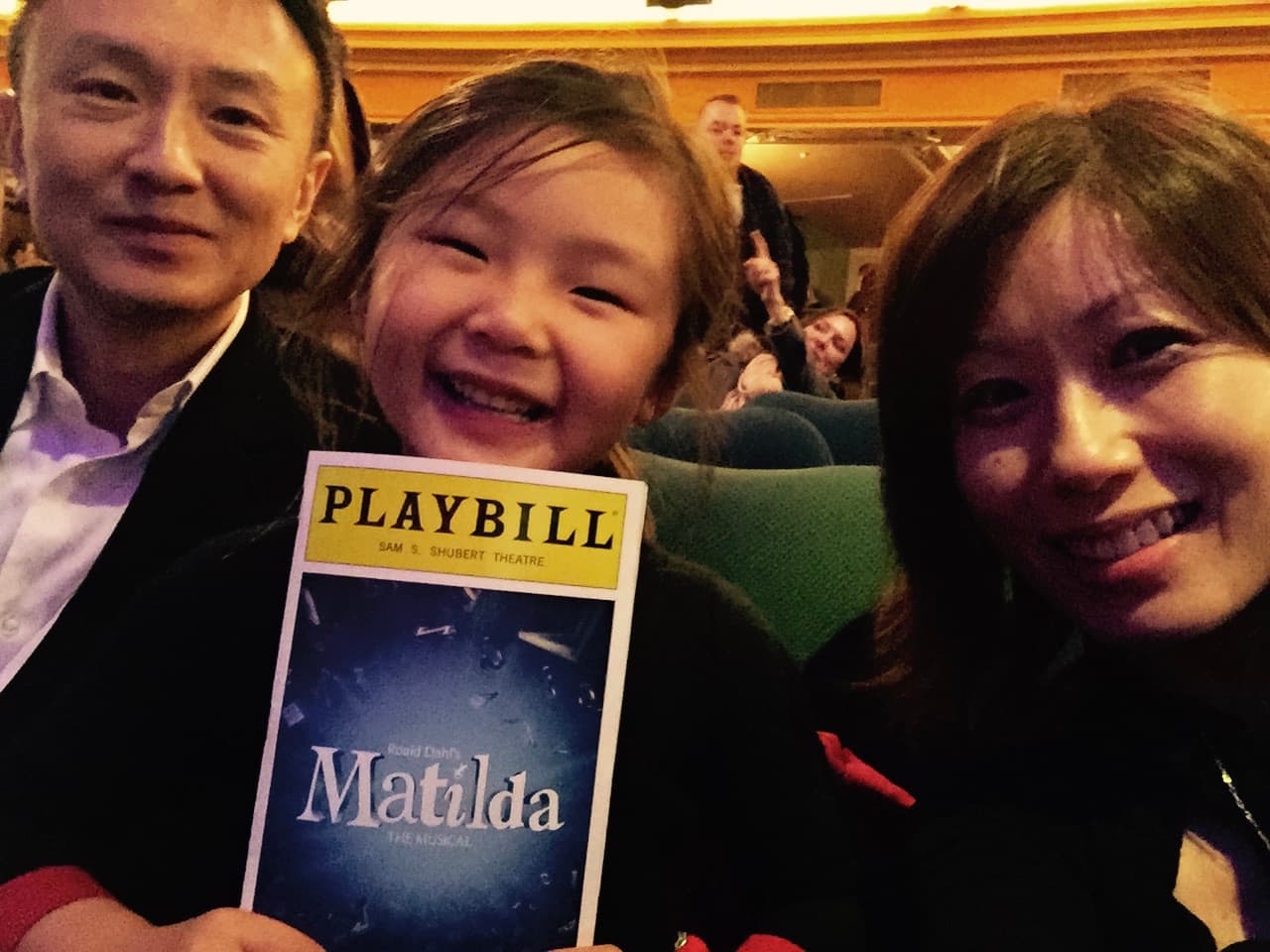
When Matilda the Musical opened at the Shubert Theatre on April 11, 2013, it transformed Roald Dahl’s story of an extraordinarily intelligent child into a musical about knowledge, imagination, power, and a child’s right to challenge adults who misuse their authority. Matilda Wormwood is a brilliant young girl born into a family that has little interest in understanding her. Her father mocks her love of books and insists that television is more valuable than reading, while her mother dismisses intellectual achievement in favor of appearance and conventional femininity. School offers little refuge. Crunchem Hall is ruled by the terrifying Miss Trunchbull, a former champion athlete who treats children as naturally guilty and uses humiliation and physical punishment to maintain control. But Matilda encounters one adult who sees her differently: Miss Honey, a gentle teacher who recognizes her extraordinary abilities.
As Matilda begins to understand both her own power and the injustice surrounding Miss Honey, she decides that recognizing something is wrong is not enough. Songs including “Naughty,” “School Song,” “Bruce,” “When I Grow Up,” “The Smell of Rebellion,” and “Revolting Children” turn childhood rebellion into a larger argument: sometimes obedience is not a virtue, particularly when the people demanding obedience are wrong.
Historical Era
Matilda first premiered with the Royal Shakespeare Company in Stratford-upon-Avon in 2010, transferred to London’s West End in 2011, and arrived on Broadway in 2013. Its origins are important. Unlike many family musicals of the period, Matilda did not emerge primarily from a major commercial entertainment company. It was developed by one of Britain’s most established theatrical institutions and brought together playwright Dennis Kelly, comedian and musician Tim Minchin, director Matthew Warchus, and choreographer Peter Darling. The result combined the accessibility of a children's story with unusually sophisticated theatrical craft. Its Broadway arrival also came during an era when adaptations of familiar books and films were increasingly central to the commercial theater. Matilda demonstrated that recognizable source material could be transformed rather than simply reproduced.
Historical & Cultural Context
Roald Dahl published Matilda in 1988, and the novel reflects themes that appear throughout his children's writing: adults can be ridiculous, cruel, vain, and deeply unfair, while children are often more perceptive than the people controlling them. That inversion is essential to Matilda. Traditional children's stories frequently teach young people to listen to adults because adults possess greater knowledge. Dahl asks what happens when they do not. Matilda's intelligence allows her to recognize hypocrisy that adults around her treat as normal. Her reading gives her access to worlds beyond the limitations of the Wormwood household. Books therefore represent more than education. Reading gives Matilda evidence that the world can be different from the one she has been given. Childhood, Authority, and “Naughty”
The musical establishes its philosophy remarkably early through “Naughty.” Matilda realizes that stories do not change unless someone changes them. She rejects the idea that being small means being powerless or that children must accept injustice simply because adults have created it. That principle drives almost every major conflict in the musical. Mr. Wormwood possesses parental authority. Miss Trunchbull possesses institutional authority. Neither automatically possesses moral authority. Matilda therefore separates following rules from doing what is right. That is a surprisingly radical idea for a family musical. The show does not teach children to reject every rule. It teaches them to think about why the rule exists and who benefits from it.
Production Innovation
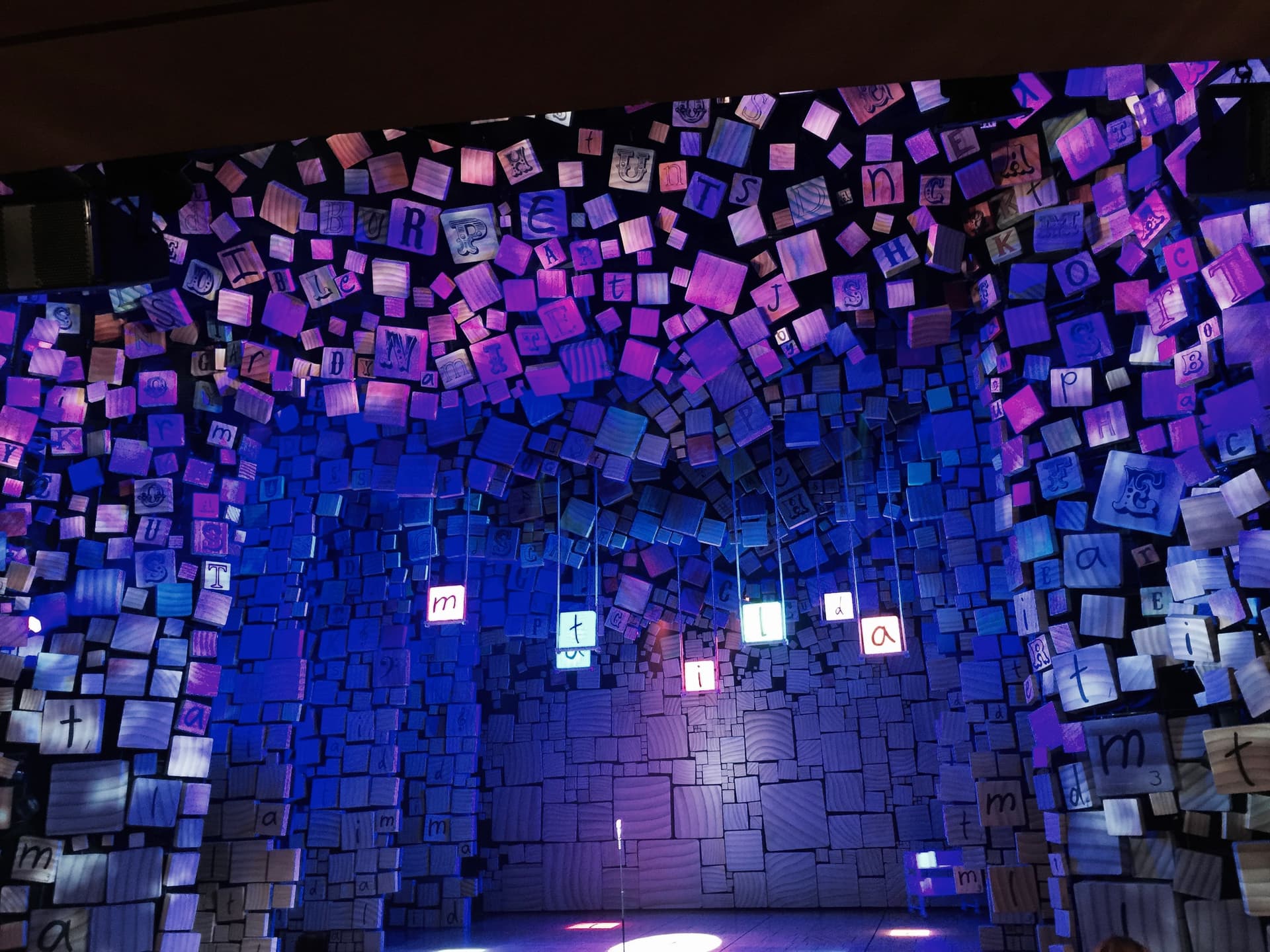
The physical production of Matilda turns language itself into scenery. Designer Rob Howell filled the theatrical world with alphabet blocks, letters, desks, chalkboards, and objects associated with childhood learning. Words are everywhere. That visual language reflects Matilda's relationship with reading and storytelling. While the adults around her often use language to lie, insult, or control, Matilda learns to use words to understand and reshape her world. One of the production's cleverest sequences is “School Song.” Older students explain the dangers of Crunchem Hall while the lyrics move systematically through the alphabet. Letters appear physically within the school gates as language, choreography, set design, and music become interconnected. The number does not merely contain clever lyrics. The alphabet becomes choreography. “When I Grow Up”
One of the musical's most emotionally complex moments is “When I Grow Up.” Children imagine adulthood as complete freedom: when they grow up, they will be tall enough to reach things, strong enough to carry what they want, and old enough to do whatever they choose. The staging famously places performers on swings, creating an image of childhood freedom and possibility. But adults eventually join the song. That changes its meaning. The audience understands something the children do not yet know: growing older does not automatically eliminate fear, uncertainty, or disappointment. Miss Honey is already grown up, yet she remains frightened by the childhood trauma inflicted by Miss Trunchbull. The song therefore allows childhood and adulthood to exist simultaneously. Growing up does not mean becoming a completely different person. Storytelling Inside the Story The musical also expands Matilda's imagination through the recurring story she tells about an Escapologist and an Acrobat. At first, the story appears to be an imaginative escape from her own unhappy home. Gradually, however, its relationship to Miss Honey becomes clear. This creates a story inside the story, allowing Matilda to uncover emotional truth through imagination before she fully understands the factual truth. The device reinforces one of the musical's central ideas: Stories are not the opposite of reality. Sometimes stories are how we learn to understand reality. That makes Matilda's obsession with books central to the musical rather than merely an endearing personality trait.
Historical Significance
Matilda had already become a major success in London before reaching Broadway, winning a then-record seven Olivier Awards in 2012, including Best New Musical.
The Broadway production received 12 Tony Award nominations and won five, including Best Book of a Musical, Best Featured Actor for Gabriel Ebert as Miss Trunchbull, Best Scenic Design, Best Lighting Design, and the Tony Honors for Excellence in the Theatre for the four young actresses alternating as Matilda. The Broadway production ran for 1,555 performances, closing in January 2017. Its success reinforced the international exchange between the West End and Broadway while establishing Matilda as one of the most important family musicals of its era. The musical later returned to the screen through the 2022 film adaptation, creating another cycle between literature, film, and theater. Family Theatre Without Simplicity Matilda is particularly significant because it refuses to equate family theater with simple theater. Children can enjoy the physical comedy, magic, rebellious students, and terrifying Trunchbull. Adults may notice different questions underneath them. What responsibilities do adults have when they hold power over children? When should rules be challenged? How do childhood experiences remain inside adults? What happens when a child's intelligence is treated as a problem rather than a possibility? The musical trusts younger audiences to understand complexity. That trust is itself part of its achievement.
Why It Resonates With Me
What I love most about Matilda is its belief that being young does not mean being incapable of understanding the world around you. Matilda's greatest power is not really her telekinesis—it is her ability to read, question, notice contradictions, and imagine alternatives. “Naughty” captures an idea I especially like: if something in the story is wrong, recognizing that fact is only the beginning; sometimes you have to participate in changing the ending. For me, Matilda also makes a powerful argument for the humanities themselves. Books and stories give Matilda more than knowledge—they give her the vocabulary to recognize injustice and the imagination to believe that her circumstances do not have to define her future.