Overview
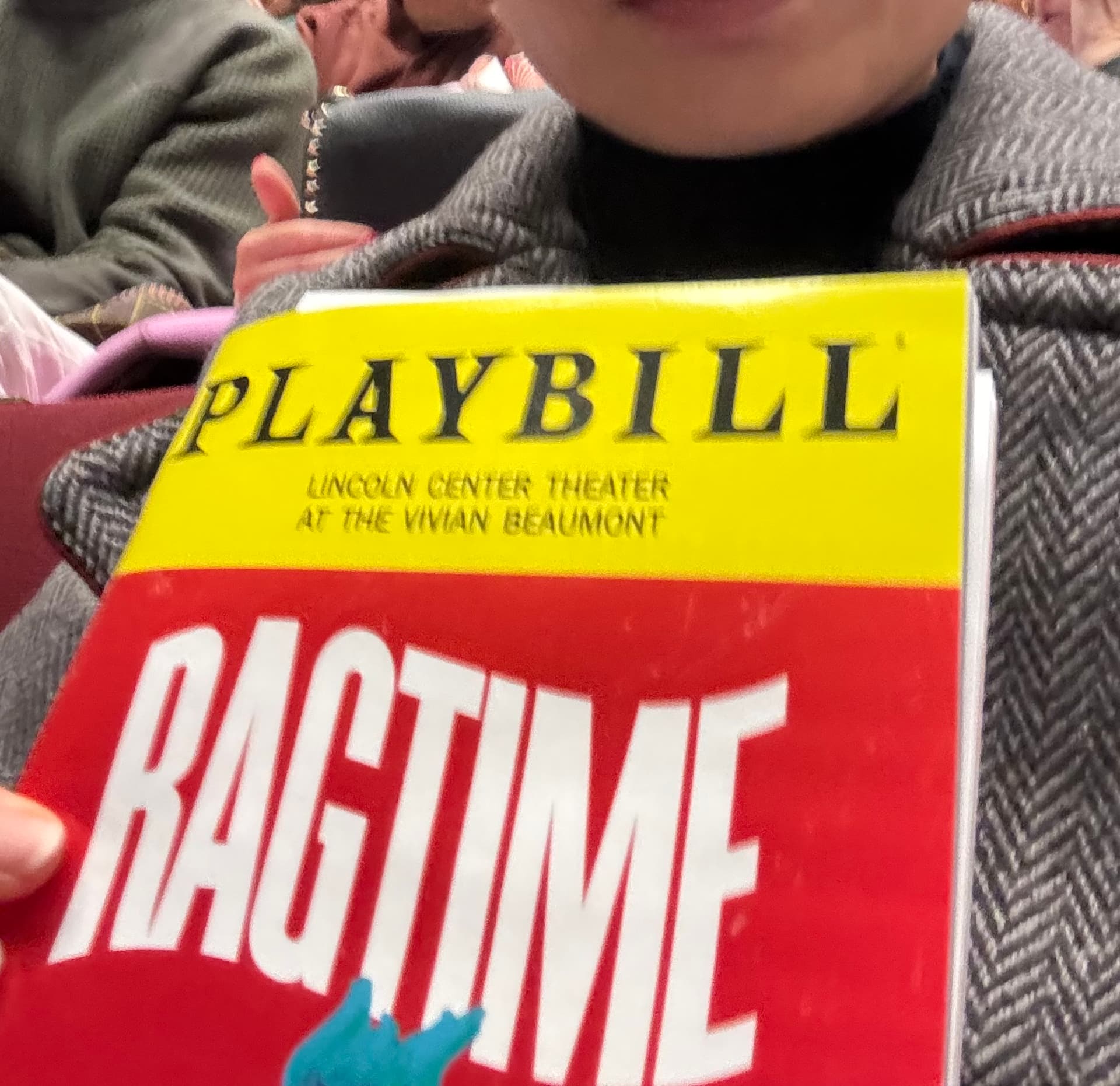
When Ragtime opened at the newly renovated Ford Center for the Performing Arts on January 18, 1998, it attempted something extraordinarily ambitious: to turn the contradictions of early twentieth-century America into a musical epic. Set primarily in New York between 1902 and 1912, Ragtime follows three communities whose lives gradually intersect. An affluent white family lives comfortably in New Rochelle; Jewish immigrant Tateh and his daughter arrive from Eastern Europe searching for opportunity; and Black pianist Coalhouse Walker Jr. seeks to build a future with Sarah and their child. Historical figures—including Harry Houdini, Emma Goldman, Booker T. Washington, Evelyn Nesbit, Henry Ford, and J. P. Morgan—move through their fictional stories, collapsing the boundary between individual lives and national history. At first, the groups appear separate. The opening number introduces them through distinct musical and social identities. But as their lives intersect, the supposedly orderly boundaries of race, class, gender, and nationality begin to break down. Songs including “Journey On,” “Getting Ready Rag,” “Wheels of a Dream,” “Till We Reach That Day,” “Back to Before,” and “Make Them Hear You” transform the promise of America into a question: who actually gets to participate in the American Dream, and what happens when that promise is denied?
Historical Era
Ragtime looks backward to the Progressive Era, a period of extraordinary transformation in the United States. Industrialization was creating enormous fortunes while producing harsh working conditions and widening economic inequality. Millions of immigrants arrived through places such as Ellis Island. Cities expanded rapidly. Automobiles, mass production, motion pictures, newspapers, and new technologies changed everyday life. At the same time, racial segregation and violence remained deeply embedded in American society. The Supreme Court's Plessy v. Ferguson decision had sanctioned “separate but equal” segregation in 1896, and Black Americans faced disenfranchisement, discrimination, and racial terror. The musical deliberately places optimism and injustice beside one another. Tateh sees America as a place where he might reinvent himself. Coalhouse believes his talent, success, and respectability should allow him to participate fully in American life.
Their experiences reveal how differently the same country can function depending upon who is trying to claim its promises.
Historical & Cultural Context
The title refers to ragtime music, a form associated particularly with Black composers such as Scott Joplin that became enormously popular around the turn of the twentieth century. Its syncopated rhythms provide more than historical atmosphere. Ragtime itself represents cultural interaction and change—the creation of new American forms through traditions that established social hierarchies attempted to keep separate. The musical's three central groups initially receive distinctive musical identities. The New Rochelle family is associated with a more formal, almost march-like sound; Tateh's immigrant world draws from Eastern European musical influences; Coalhouse's story incorporates ragtime, gospel, and other Black musical traditions. As the characters' lives intersect, those musical worlds increasingly interact as well. The score therefore makes the argument that American identity is created through encounters between people who initially appear to inhabit separate worlds. Race, Justice, and the American Dream Coalhouse Walker Jr.'s story gives Ragtime its most devastating examination of American equality. Coalhouse begins as a confident, successful musician. He purchases a Model T Ford, dresses elegantly, and courts Sarah with deliberate formality. He believes that if he behaves with dignity, the society around him should recognize that dignity. Then racist firefighters vandalize his car. Coalhouse initially responds through institutions. He seeks legal redress and expects the law to protect his property and rights. It does not. His transformation is therefore crucial. Coalhouse does not begin as a revolutionary. He becomes radicalized after discovering that the ordinary mechanisms of justice available to white Americans will not function for him in the same way. His story turns Ragtime's central question from aspiration to accountability: what happens when a nation teaches people to believe in equality but repeatedly refuses to provide it?
Production Innovation
The original production of Ragtime matched the enormous scale of its subject.
Directed by Frank Galati, it used a large cast, expansive scenery, projections, period imagery, elaborate costumes, and a sweeping orchestral score to create the sensation of an entire nation moving through historical change. But one of its most effective devices is structural rather than technological. The opening number, “Ragtime,” begins by separating the characters physically and musically into groups. Each community describes the others through stereotypes and assumptions. Then the groups begin moving toward one another. That staging establishes the entire musical in miniature: separate American worlds will collide, and none will remain unchanged. The musical also moves constantly between enormous public events and intimate personal stories. A political rally can give way to a family conversation; famous historical figures can appear beside fictional characters. History is therefore not something happening somewhere beyond ordinary life. History happens to people.
Historical Significance
Ragtime arrived during an unusually important period in 1990s Broadway. Rent had recently brought contemporary youth culture and the AIDS crisis to the center of musical theatre. Disney's The Lion King was radically reimagining the possibilities of commercial spectacle. Ragtime offered another model: the large-scale historical musical as an examination of national identity. The original production received 13 Tony Award nominations and won four, including Best Book for Terrence McNally and Best Original Score for Ahrens and Flaherty. Audra McDonald won Best Featured Actress in a Musical for her performance as Sarah. Despite critical acclaim, the original production's enormous costs contributed to its relatively short Broadway life of 834 performances. Its artistic reputation, however, continued to grow. Later revivals have often used simpler staging, demonstrating that the musical's power does not depend entirely on its original spectacle. Its combination of fictional characters and historical figures also anticipates later Broadway works that interrogate American history and mythology through contemporary theatrical storytelling. Historical Significance and the American Story
Perhaps Ragtime's most important contribution is its refusal to present American history as a single narrative. Mother discovers possibilities beyond the gender expectations of her marriage. Tateh moves from impoverished immigrant to successful filmmaker. Coalhouse's faith in American justice collapses. Younger Brother becomes politically radicalized. Their lives unfold simultaneously. No single character can explain America. Even the concept of progress becomes unstable. The automobile represents technological possibility, yet Coalhouse's Model T becomes the object through which racist violence enters his life. Industrialization creates opportunity while producing exploitation. Immigration allows reinvention while demanding enormous sacrifice. Ragtime therefore treats American history as multiple stories occupying the same space—sometimes harmonizing, sometimes colliding.
Why It Resonates With Me
What I find most powerful about Ragtime is that it refuses to reduce American history to either progress or injustice. Both exist at once. Tateh can genuinely find opportunity while Coalhouse can genuinely discover that equality has limits; technological innovation can create new possibilities while old racial and social hierarchies remain intact. The opening begins with communities convinced that they understand one another from a distance, but the musical gradually forces their stories together. For me, that is what makes Ragtime such an important historical musical: it does not ask which single story represents America. It asks how America is created from all of those stories colliding, contradicting, and changing one another.