Overview
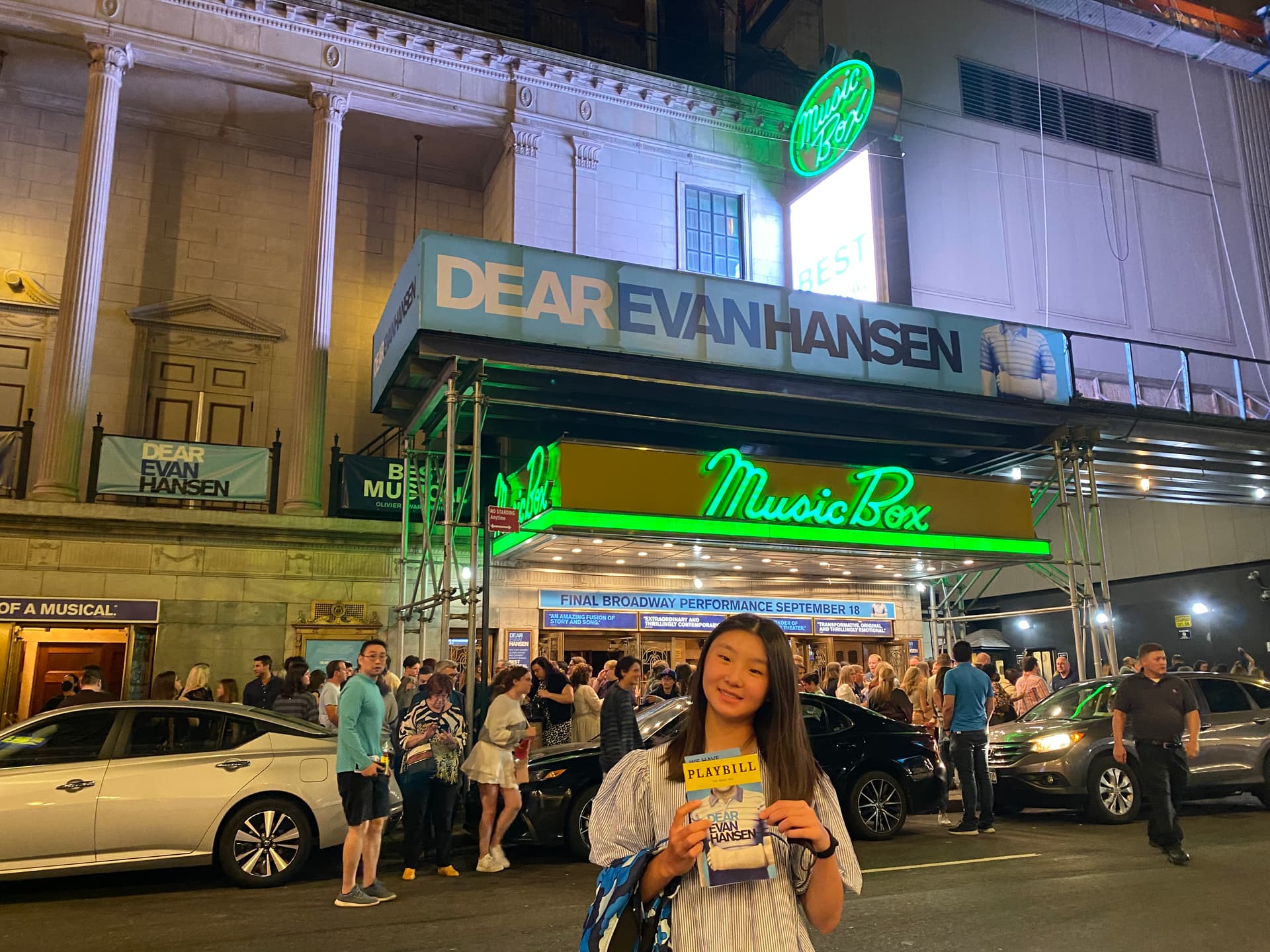
When Dear Evan Hansen opened at the Music Box Theatre on December 4, 2016, it brought a distinctly twenty-first-century world onto Broadway: teenagers communicating through screens, identities shaped online, and a private misunderstanding capable of becoming a public story almost instantly.
Evan Hansen is a socially isolated high-school student who has been instructed to write encouraging letters to himself. One begins, “Dear Evan Hansen,” and describes his loneliness and his feelings for classmate Zoe Murphy. Zoe’s brother Connor finds the letter. Soon afterward, Connor dies by suicide, and the letter is found with him. Connor’s parents mistakenly conclude that their son wrote it to Evan and that the two boys had secretly been friends. Evan knows this is untrue. But instead of correcting them, he begins constructing the friendship they desperately want to believe existed. The lie gives Connor’s parents comfort and gives Evan something he has long wanted: connection. As fabricated emails, social media, and the viral Connor Project turn a private deception into a public movement, Evan increasingly loses control of the story he created. Songs including “Waving Through a Window,” “For Forever,” “Requiem,” “You Will Be Found,” and “Words Fail” explore loneliness, grief, belonging, and the complicated distance between being noticed and truly being known.
Historical Era
Dear Evan Hansen emerged in the mid-2010s, when social media had become deeply embedded in teenage social life. Facebook, Twitter, Instagram, YouTube, texting, and other digital platforms had transformed how young people communicated and how quickly personal experiences could become public narratives. The musical does not treat technology simply as background. It asks what happens when human vulnerability meets networked communication. Evan’s initial lie is small and private. Earlier generations might have allowed it to remain confined to a few people. But online, the Connor Project grows beyond him. Messages are shared, videos spread, strangers participate, and thousands of people construct their own version of Connor. The scale of the deception therefore becomes possible partly because the technology of Evan’s world allows stories to travel farther and faster than the people who originally created them.
Historical & Cultural Context
The musical also arrived amid growing public discussion about adolescent isolation, mental health, bullying, and the emotional effects of digital life.
But Dear Evan Hansen is not simply a musical about social media being harmful. Technology functions in contradictory ways. Evan feels invisible while surrounded by digital communication. Yet the same network allows “You Will Be Found” to reach people who genuinely feel comforted by its message. That creates one of the musical’s most interesting tensions: Can a message become meaningful even when the story that produced it is false? People who respond to the Connor Project do not know Evan’s deception. Their feelings of loneliness and their desire for connection are nevertheless real. The musical separates the authenticity of the storyteller from the emotional effect of the story. Social Media as Theatrical Language The original production made the digital world physically present onstage. David Korins’s scenic design and Peter Nigrini’s projections surrounded the performers with screens, messages, social-media feeds, photographs, and constantly shifting digital information. At moments, characters appear almost swallowed by the communication happening around them. This was more than contemporary decoration. Traditionally, musical theater must find ways to make internal or invisible experiences visible. Dear Evan Hansen used projection technology to represent the information environment its characters inhabit. When Evan’s story becomes viral, the stage itself becomes increasingly crowded with digital responses. The production therefore transformed something normally experienced individually through a phone or laptop into a collective theatrical space. “Waving Through a Window” The musical establishes its central metaphor in “Waving Through a Window.” Evan imagines himself outside the social world, able to see other people but unable to participate fully. The image perfectly captures a paradox of digital culture. A person can observe hundreds of other lives through screens and still feel completely isolated. Visibility is not necessarily connection. Being followed is not the same as being known.
That distinction becomes increasingly important as Evan gains enormous online visibility while simultaneously becoming less honest about who he actually is. The more people see the public version of Evan, the harder it becomes for anyone to see the real one. Grief Without a Simple Victim One of the musical’s most complicated choices is its portrayal of Connor through the people who survive him. Connor dies early, meaning the audience never receives a complete, reliable account of who he was. Evan invents an idealized version. Connor’s parents remember different aspects of their son. Zoe refuses to romanticize him and recalls the fear and pain he caused within their family. Her response in “Requiem” challenges the expectation that death automatically requires survivors to transform a difficult person into someone uncomplicatedly lovable. That makes Connor another example of the musical’s larger concern with narrative. After someone can no longer speak for himself, other people begin constructing the story of who he was. Representation and Controversy Dear Evan Hansen became enormously popular, particularly among younger audiences, but it also generated substantial debate. Some audiences saw Evan as a deeply flawed teenager whose desperate desire for connection leads him into increasingly damaging decisions. Others believed the musical treated his deception too sympathetically, particularly because he benefits emotionally and socially from a false relationship with a dead classmate. The show's treatment of mental health and suicide has also been debated. These disagreements are important to its historical significance. Dear Evan Hansen does not offer an uncomplicated hero. Instead, it places audiences in the uncomfortable position of understanding why someone makes harmful choices without necessarily excusing those choices.
That tension became even more visible when the musical was adapted into a 2021 film, where changes in medium, casting, and audience expectations produced a substantially different critical response.
Historical Significance
The original Broadway production starred Ben Platt as Evan Hansen, with Rachel Bay Jones, Jennifer Laura Thompson, Michael Park, Laura Dreyfuss, Mike Faist, Will Roland, and Kristolyn Lloyd. At the 2017 Tony Awards, Dear Evan Hansen won six awards, including Best Musical, Best Original Score, Best Book, Best Actor for Platt, and Best Featured Actress for Jones. The production became one of the defining Broadway musicals of the late 2010s, particularly for teenage and young-adult audiences. Songs such as “Waving Through a Window” and “You Will Be Found” circulated far beyond the theater through streaming platforms, social media, concerts, and online performances. That distribution was especially appropriate for a musical concerned with how messages escape their original contexts and acquire lives of their own. Broadway in the Digital Age Earlier musicals in this exhibition reveal how new technologies repeatedly changed theatrical storytelling. Show Boat emerged alongside transformations in American popular entertainment. Singin’ in the Rain-era stories responded to film and recorded sound. Rent reflected a generation shaped by television and mass media. Dear Evan Hansen belongs specifically to the networked age. Its characters do not simply use technology. They construct versions of themselves through it. The musical therefore captures a major twenty-first-century shift in identity: people increasingly exist simultaneously as physical individuals and as collections of posts, messages, photographs, videos, and stories visible to other people. The question becomes not simply “Who am I?” It becomes “Which version of me are other people seeing?”
Why It Resonates With Me
What interests me most about Dear Evan Hansen is its distinction between visibility and genuine connection. Evan spends much of the musical wanting people to notice him, but when they finally do, they are responding partly to a version of himself that he has constructed. That feels especially relevant to
a generation growing up with social media, where it is incredibly easy to curate how other people perceive us. I also find the Connor Project fascinating because a false story produces emotions that are genuinely real for thousands of strangers. For me, the musical raises a very contemporary question: when technology allows stories to spread far beyond the people who created them, who is responsible for what those stories become?