Overview
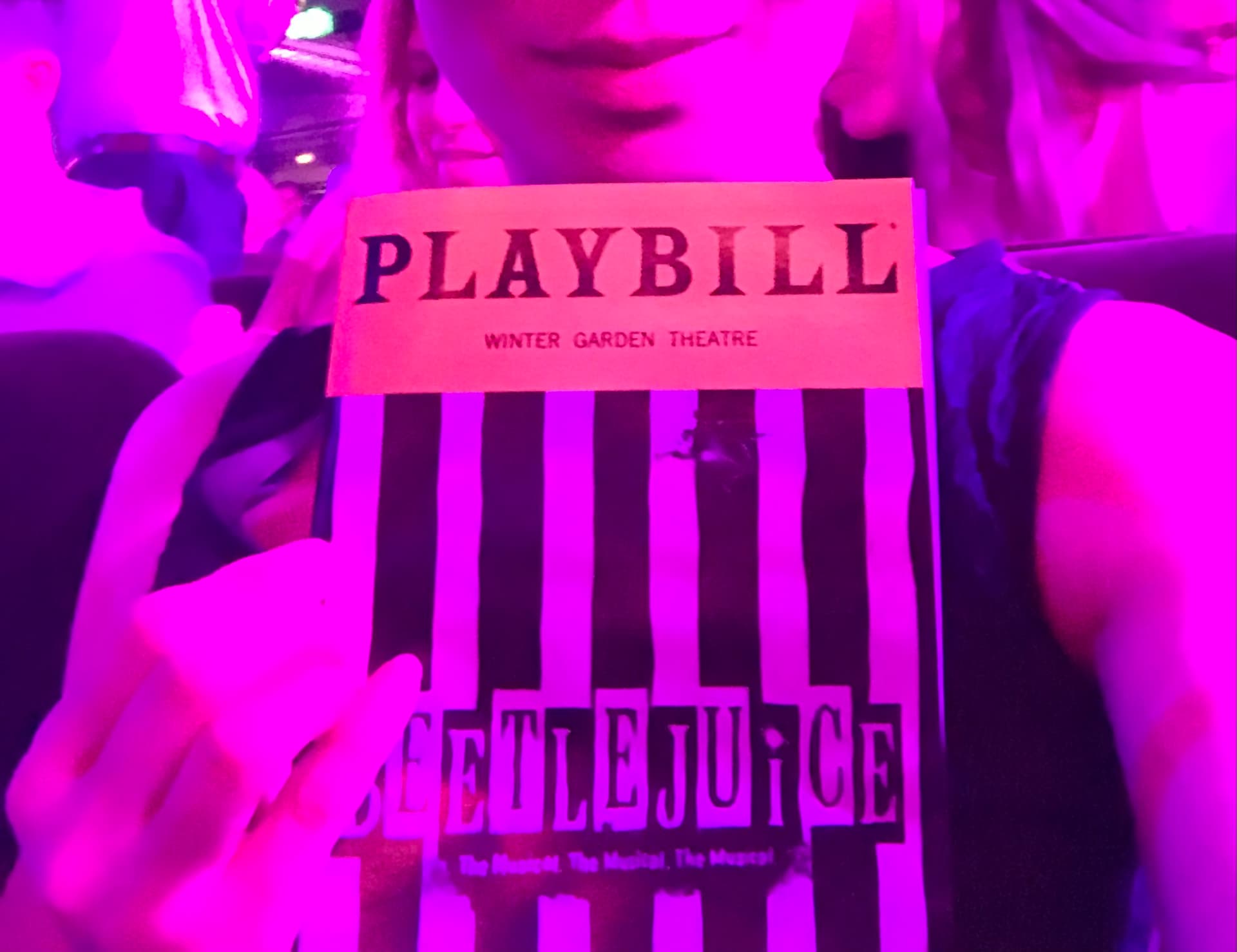
When Beetlejuice opened at the Winter Garden Theatre on April 25, 2019, it transformed Tim Burton’s cult film into a loud, visually extravagant, and unexpectedly emotional musical about death, grief, loneliness, and the desire to be seen. The musical centers on Lydia Deetz, a teenager grieving the death of her mother. Her father, Charles, wants to move forward with his new partner, Delia, but Lydia feels that doing so means pretending her mother never existed. Then Lydia discovers that their new house is haunted. Its former owners, Barbara and Adam Maitland, have recently died and are struggling to understand their new existence as ghosts. Lydia can see them—and she can also see Beetlejuice, a chaotic demon who desperately wants a living person to say his name three times so that he can become visible to everyone. Lydia and Beetlejuice form a dangerous partnership. Both feel ignored by the living world, but their responses to invisibility are radically different. Songs including “The Whole ‘Being Dead’ Thing,” “Dead Mom,” “Say My Name,” “No Reason,” “Home,” and “Creepy Old Guy” combine horror, comedy, rock, pop, and Broadway spectacle. Beneath all the supernatural chaos is a surprisingly human question: what do we do when the person we most want to see again is the one person we cannot bring back?
Historical Era
Beetlejuice arrived on Broadway in 2019, during an era increasingly shaped by adaptations of familiar films and entertainment properties. From The Producers and Hairspray to Mean Girls, Frozen, and School of Rock, film-to-stage adaptations had become a central part of Broadway’s commercial ecosystem. Beetlejuice clearly belonged to that trend. But director Alex Timbers and the creative team did not simply recreate Burton’s film scene by scene. The musical substantially changed the story’s emphasis, making Lydia a much more central character and giving Beetlejuice direct interaction with the audience. The result illustrates an important principle of successful adaptation: theater works best when it asks what the stage can do differently from film rather than simply attempting to imitate the screen. From Tim Burton to Broadway
Tim Burton’s 1988 film centered primarily on Adam and Barbara Maitland, with Michael Keaton’s Beetlejuice appearing for a surprisingly limited amount of screen time. The Broadway musical reorganizes that structure. Beetlejuice becomes master of ceremonies, narrator, antagonist, comedian, and audience provocateur. Lydia also becomes the emotional center of the story. Her grief over her mother—far less central in the film—provides the musical with a dramatic through-line that connects its most outrageous comedy to something emotionally recognizable. This creates an unusual combination. The show can stage an enormous supernatural production number one moment and then allow Lydia to sing quietly about grief the next. The tonal instability is intentional. For Lydia, death is simultaneously terrifying, fascinating, absurd, and deeply personal. Grief Beneath the Comedy The musical announces its subject immediately. Beetlejuice begins by reminding the audience that everyone is going to die. But where Beetlejuice treats mortality as a joke, Lydia experiences it as absence. In “Dead Mom,” she tries to communicate with the mother she has lost while expressing anger toward her father for appearing to move on. That anger drives many of her choices. Lydia initially believes that reconnecting with her mother would solve her grief. Her fascination with the supernatural therefore becomes more than teenage gothic style. She wants evidence that death is reversible. Over the course of the musical, she gradually confronts a harder truth: continuing to live does not require forgetting the person who died.
Production Innovation
Beetlejuice became one of the most technically elaborate musicals of its period.
David Korins’s scenic design transformed the Maitland/Deetz house repeatedly, while Kenneth Posner’s lighting, Peter Hylenski’s sound, William Ivey Long’s costumes, projection design, puppetry, illusions, and special effects created a world that could change almost instantaneously. The house itself appears to respond to the supernatural forces occupying it. Beetlejuice’s costumes also change color depending upon his surroundings and emotional state, turning clothing into part of the show's visual storytelling. Rather than hiding theatrical machinery, the production often revels in it. Doors open unexpectedly. Objects move. Monsters appear. The house transforms. The audience is constantly invited to ask: How did they do that live? Breaking the Fourth Wall One of the musical’s most important changes from the film is Beetlejuice’s relationship with the audience. He knows he is in a musical. He comments on the plot, reacts to applause, makes jokes about Broadway conventions, and repeatedly acknowledges the people watching him. That makes the audience part of his desire for visibility. At the beginning, most characters cannot see Beetlejuice. But we can. He therefore develops a relationship with the audience before he develops one with the living characters. The device connects Beetlejuice to the Broadway self-awareness of The Producers, Spamalot, and The Book of Mormon. The show understands Broadway’s conventions well enough to make those conventions part of the joke. Technology and Theatrical Illusion Beetlejuice also represents an interesting stage in the relationship between Broadway and theatrical technology. Film can create supernatural effects through editing and digital manipulation.
Theater has a different challenge: the transformation has to appear to happen in the same physical space occupied by the performers and audience. That limitation becomes an advantage. When Beetlejuice performs impossible actions or the house suddenly transforms, audiences know they are watching machinery, lighting, illusion, puppetry, and human coordination. Yet the effect can still feel magical. Like The Lion King, Wicked, and Mary Poppins, Beetlejuice demonstrates that modern Broadway spectacle is often most exciting not when technology becomes invisible, but when technology and human performance work together to make the impossible appear physically present.
Historical Significance
The original Broadway production starred Alex Brightman as Beetlejuice and Sophia Anne Caruso as Lydia, with Rob McClure, Kerry Butler, Leslie Kritzer, Adam Dannheisser, and others. The production received eight Tony Award nominations, including Best Musical and Best Actor in a Musical for Brightman. Its Broadway history became unusually complicated. Despite initially mixed critical reception, the show gradually developed an intensely loyal audience, particularly among younger theatergoers. Social media, fan art, online performances, and the cast recording helped transform it into a cult Broadway phenomenon. The production was scheduled to leave the Winter Garden Theatre in 2020 to make room for The Music Man. Then the COVID-19 pandemic shut down Broadway before its planned final performance. Remarkably, that was not the end. The Broadway Resurrection In April 2022, Beetlejuice returned to Broadway at the Marquis Theatre. A Broadway production reopening after losing its original theater is highly unusual. In this case, it also seemed almost perfectly appropriate. A musical about refusing to stay dead had effectively come back from the dead. Its return demonstrated the growing influence of fandom on Broadway economics. The show's audience had not simply consumed the production; fans had helped maintain its cultural visibility during the shutdown.
This makes Beetlejuice particularly important to understanding Broadway in the social-media era. A show's historical life is no longer determined only by reviews, Tony Awards, and traditional advertising. Audiences can participate in keeping a production culturally alive.
Why It Resonates With Me
What I find most interesting about Beetlejuice is how something so technologically elaborate ultimately depends on a very simple emotional idea: Lydia wants someone who is gone to come back. All the projections, puppetry, illusions, moving scenery, and supernatural effects create a world in which almost anything seems possible, but the one thing Lydia actually wants cannot be accomplished. I also think the show's unusual Broadway history matters. Its fans helped turn a production that initially seemed vulnerable into a cultural phenomenon strong enough to return after the shutdown. For me, Beetlejuice represents a new kind of Broadway relationship in which audiences do not just watch a show—they build communities around it, reinterpret it online, and can even help determine how long its life continues beyond the theater.