Overview
When Sweeney Todd: The Demon Barber of Fleet Street opened at the Uris Theatre on March 1, 1979, Stephen Sondheim and Hugh Wheeler transformed a Victorian tale of murder into something far more ambitious: a musical about revenge, class, industrial society, and the destructive consequences of injustice. Sweeney Todd returns to London after fifteen years of wrongful transportation to Australia. Once known as Benjamin Barker, he discovers that Judge Turpin—the man responsible for his exile—has taken his daughter Johanna as his ward after pursuing Sweeney's wife, Lucy. Consumed by revenge, Sweeney reopens his barber shop above Mrs. Lovett's struggling meat-pie business. When his attempt to kill Turpin is frustrated, Sweeney's desire for revenge expands into indiscriminate violence. He begins murdering his customers, while Mrs. Lovett turns their bodies into meat pies. The grotesque premise produces moments of dark comedy, but the musical never allows the violence to remain merely ridiculous. Songs including “The Ballad of Sweeney Todd,” “A Little Priest,” “Johanna,” “Epiphany,” and “Not While I’m Around” create a world in which tenderness and brutality exist disturbingly close together. The result is simultaneously horror story, black comedy, tragedy, and social critique.
Historical Era
Sweeney Todd premiered in 1979, at the end of a decade in which Broadway had radically expanded the possibilities of musical form. Works such as Company, Follies, A Little Night Music, Chicago, and A Chorus Line had already challenged the conventional structures and moral certainty associated with earlier musical theatre. With Sweeney Todd, Sondheim demonstrated that a Broadway musical could approach the scale and darkness of grand tragedy. The production also emerged during a period of American economic uncertainty. New York had recently experienced its fiscal crisis, industrial decline was reshaping cities, and distrust of institutions remained strong after Vietnam and Watergate. Although the musical is set in nineteenth-century London, its vision of a society divided between powerful elites and economically desperate ordinary people resonated with contemporary anxieties. Sweeney's London is not simply a historical setting. It is a system that seems to manufacture suffering.
Historical & Cultural Context
The character of Sweeney Todd had existed in British popular culture since the nineteenth century, appearing in the 1846–47 penny dreadful The String of Pearls and numerous later stage adaptations. Earlier versions generally treated Sweeney as a sensational villain. Christopher Bond's 1973 play fundamentally changed the character by giving his violence a psychological and social origin. Sweeney became a man destroyed by an abusive system before becoming destructive himself. Sondheim and Wheeler developed that interpretation further. Judge Turpin represents institutional power without accountability. He can exile Benjamin Barker, destroy his family, and use his authority to control Johanna. Sweeney's response begins as personal revenge but gradually becomes something larger. In “Epiphany,” he decides that his anger applies not simply to Turpin but to humanity itself. Society has divided people between those who exploit and those who are exploited, and Sweeney imagines murder as a grotesque equalizer. Mrs. Lovett turns that philosophy into economics. Her meat-pie business literally transforms human beings into commodities. The poor consume one another while the powerful remain above them. The joke is horrifying because the metaphor is so clear: in an unequal society, people can become material for someone else's profit.
Production Innovation
The original production, directed by Harold Prince, emphasized this social interpretation through monumental industrial staging. Designer Eugene Lee created a vast environment dominated by iron, machinery, staircases, and a nineteenth-century factory structure. Rather than presenting Sweeney's barber shop as an isolated Gothic location, the production placed his story inside the machinery of industrial London. Sondheim's score matched that scale. Sweeney Todd is one of his most musically complex works, drawing on operatic structures, horror-film sounds, Victorian popular music, romantic lyricism, and recurring musical motifs. The opening “Ballad of Sweeney Todd” establishes the company as storytellers who repeatedly return to narrate and judge Sweeney's story. The famous “Dies Irae” motif—a musical phrase historically associated with death—appears throughout the score. Sondheim also repeatedly places beautiful music beside horrifying circumstances. “Pretty Women” allows Sweeney and Judge Turpin to sing together about beauty while Sweeney prepares to murder him. “A Little Priest” turns cannibalism into an elaborate sequence of puns. “Johanna” becomes associated with longing and innocence even as violence spreads across London. The contrast forces audiences to experience attraction and revulsion simultaneously.
Historical Significance
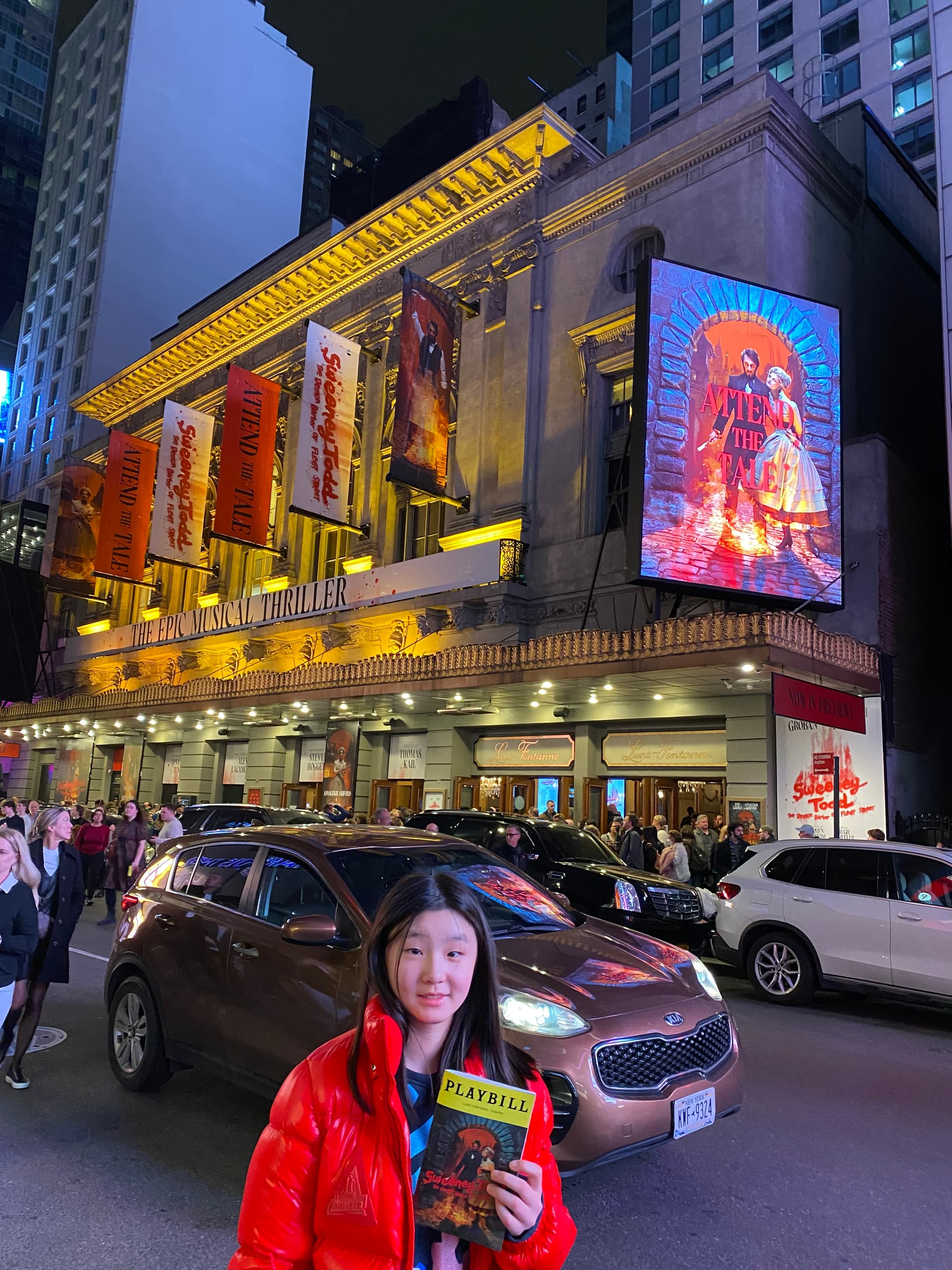
The original production starred Len Cariou as Sweeney Todd and Angela Lansbury as Mrs. Lovett and won eight Tony Awards, including the 1979 Tony Award for Best Musical, Best Original Score, Best Book, Best Actor, and Best Actress. Its historical importance lies partly in the scale of Sondheim's ambition. By 1979, the musical had traveled an extraordinary distance from the conventions of earlier Broadway comedy. Sweeney Todd demonstrated that musical theatre could sustain murder, psychological obsession, social criticism, operatic complexity, and moral ambiguity without sacrificing theatrical entertainment. The work has also proved remarkably adaptable. The 2005 Broadway revival, directed by John Doyle, stripped away the massive original production and had the actors play the instruments themselves, transforming the story into an intimate psychological chamber piece. The 2023 Broadway revival, starring Josh Groban and Annaleigh Ashford, moved in the opposite direction, restoring a large orchestra and emphasizing the sweeping musical power of Sondheim's score. Those productions reveal something important about the work: Sweeney Todd can survive both enormous spectacle and radical simplicity because its dramatic architecture is so strong.
It also stands as one of the clearest examples of Stephen Sondheim's transformation of the Broadway musical into a vehicle for complex psychological and philosophical storytelling.
Why It Resonates With Me
What fascinates me about Sweeney Todd is that it never allows me to decide comfortably whether Sweeney is a victim or a villain. He begins with a legitimate grievance against a corrupt system, but eventually uses that injustice to justify harming people who had nothing to do with it. The musical asks a question that feels larger than revenge: when someone has been genuinely wronged, at what point does explaining what they become stop being the same thing as excusing it? That ambiguity—and the fact that Sondheim expresses it through music that can be beautiful, funny, and terrifying almost simultaneously—is what makes Sweeney Todd feel like such a major turning point in Broadway history.