Overview
When Sunset Boulevard opened at Broadway's Minskoff Theatre on November 17, 1994, it transformed Billy Wilder's classic film noir into a musical about fame, aging, reinvention, and the brutal instability of an industry built on attention. The musical follows Joe Gillis, a struggling screenwriter in Hollywood who accidentally enters the decaying mansion of Norma Desmond, a former silent-film star who still believes she belongs at the center of the entertainment world. Norma hires Joe to edit Salome, the enormous screenplay she believes will mark her triumphant return to the screen. Joe recognizes that the project is unrealistic, but Norma's wealth offers him an escape from his financial problems. He becomes increasingly trapped inside her carefully constructed world while secretly working on another screenplay with young writer Betty Schaefer. Norma's fantasy eventually collapses, with devastating consequences. Songs including “With One Look,” “As If We Never Said Goodbye,” “The Greatest Star of All,” and the title song explore a world where artistic identity and public recognition have become almost impossible to separate. Norma's tragedy is not simply that she was once famous and no longer is. It is that she built her identity around an audience that eventually stopped looking.
Historical Era
Sunset Boulevard premiered in London's West End in 1993 and arrived on Broadway the following year, during the final major phase of the British-led megamusical era. Andrew Lloyd Webber had already achieved extraordinary international success with Evita, Cats, and The Phantom of the Opera. Along with productions such as Les Misérables and Miss Saigon, these works had helped reshape Broadway into a global commercial industry built around large-scale spectacle, powerful visual identities, and productions capable of traveling internationally. Sunset Boulevard inherited that tradition but turned its attention toward an industry built on spectacle itself: Hollywood. Its story looks backward to the transition from silent cinema to synchronized sound in the late 1920s and early 1930s, when technological change rapidly altered the careers of actors, directors, musicians, and other film professionals.
For Norma, that transformation is not abstract history. Technology has helped make the artistic identity she spent years building obsolete.
Historical & Cultural Context
Norma Desmond is fictional, but her story draws upon a real transformation in film history. During the silent era, stars communicated primarily through physical expression, gesture, and title cards. The arrival of synchronized sound changed what Hollywood demanded from performers. Some silent stars successfully transitioned; others saw their careers decline. Sunset Boulevard turns that industrial change into personal tragedy. Norma cannot accept the distinction between having once been famous and still being culturally relevant. She surrounds herself with photographs, watches her old films, receives fan mail secretly written by her loyal butler Max, and interprets attention as evidence that the world still awaits her return. Yet the musical also complicates the temptation to laugh at her. Norma really was a star. Her talent and fame were not imaginary. The industry celebrated her intensely and then moved on. Her famous insistence that the pictures became small rather than she herself becoming less important expresses both delusion and a legitimate grievance against an entertainment system that treats people as disposable.
Production Innovation
The original Sunset Boulevard became famous for its enormous physical production, particularly Norma Desmond's mansion. Designer John Napier created a monumental set that could rise above the stage, revealing different spaces underneath and allowing the production to move cinematically between Norma's enclosed world and the working Hollywood outside it. The mansion becomes more than scenery. It is a physical representation of Norma's mind: magnificent, theatrical, isolated, and trapped in the past. Lloyd Webber's sweeping score reinforces that scale. Norma's two great solos—“With One Look” and “As If We Never Said Goodbye”—allow her to reclaim temporarily the command she once possessed as a star. “As If We Never Said Goodbye” is particularly complex. Norma returns to a film studio believing she is preparing for a professional comeback. The workers recognize her and gather around. For a moment, the old machinery of celebrity switches back on.
The audience knows the comeback is an illusion. Norma does not.
Historical Significance
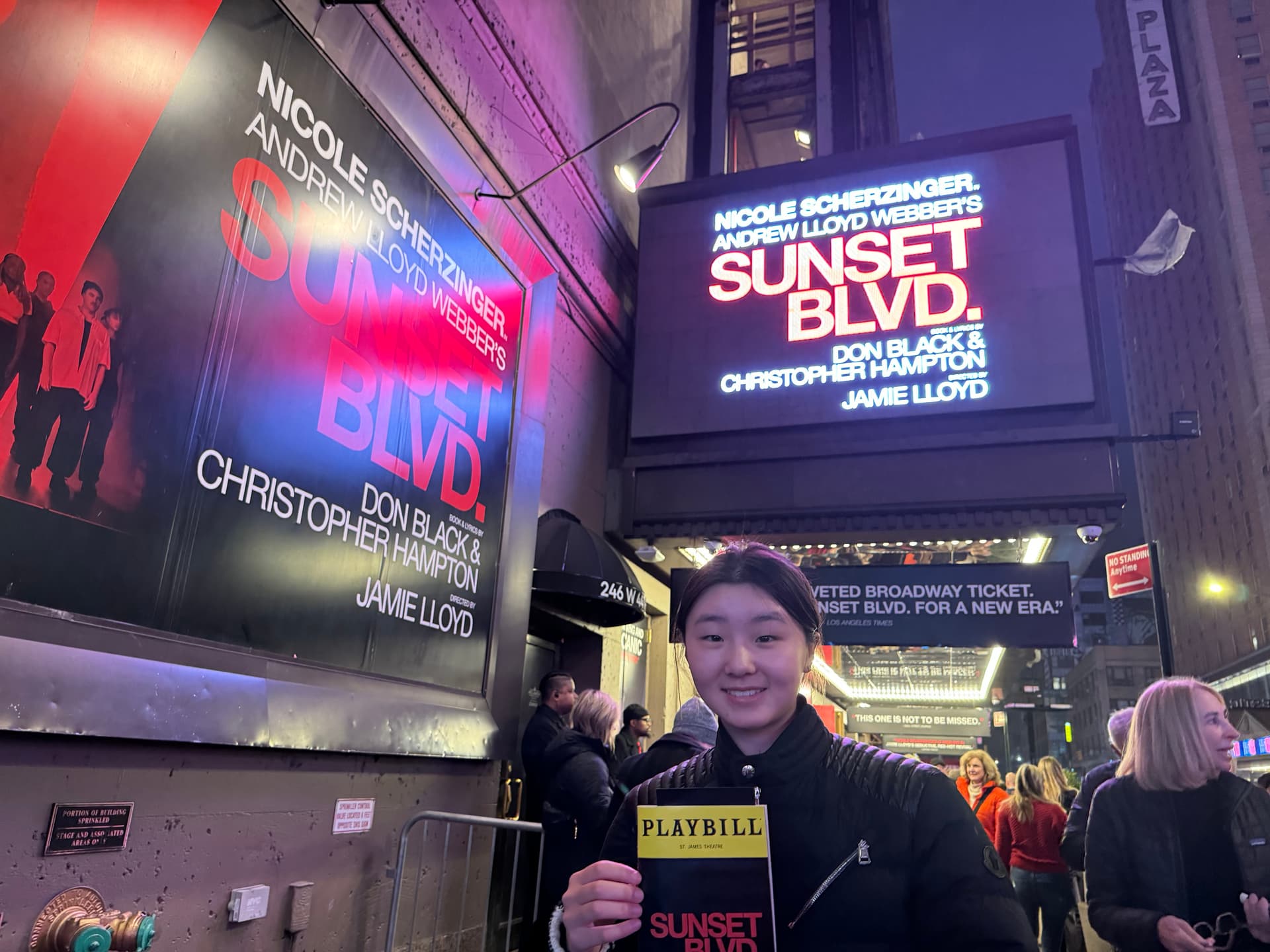
The Broadway production starred Glenn Close as Norma Desmond, whose performance became one of the defining interpretations of the role. The production won seven Tony Awards, including the 1995 Tony Award for Best Musical, Best Original Score, and Best Actress for Close. Its production history was also famously turbulent. Casting disputes and lawsuits surrounding the London and Broadway productions became part of the show's own mythology—appropriately enough for a musical about the instability and competitiveness of show business. The role of Norma subsequently attracted major performers including Patti LuPone, Betty Buckley, Elaine Paige, and others. The musical's revival history has been especially revealing. Glenn Close returned to the role for a 2017 Broadway revival, but the radical 2024 Broadway revival, directed by Jamie Lloyd and starring Nicole Scherzinger, fundamentally reimagined the work. Rather than recreating Norma's mansion through enormous scenery, the production used a stark visual environment, cameras, and live video. A musical once famous for physical spectacle became a musical about the camera itself. That reinterpretation was particularly appropriate. Norma's deepest desire has always been to be seen. By placing cameras constantly around the performers, the revival connected her obsession with the mechanisms of contemporary celebrity and image-making. It demonstrated how radically theatrical form can change while the central idea of a musical remains intact.
Why It Resonates With Me
What fascinates me about Sunset Boulevard is how differently Norma's obsession with visibility reads today. Her world depends on cameras, audiences, public recognition, and the fear that attention can disappear without warning—all things that feel even more familiar in an age of social media and personal branding. What makes her tragic is that her fame was once completely real. The musical makes me wonder what happens when external recognition becomes part of how we understand ourselves—and who we are when the audience eventually looks somewhere else.