Overview
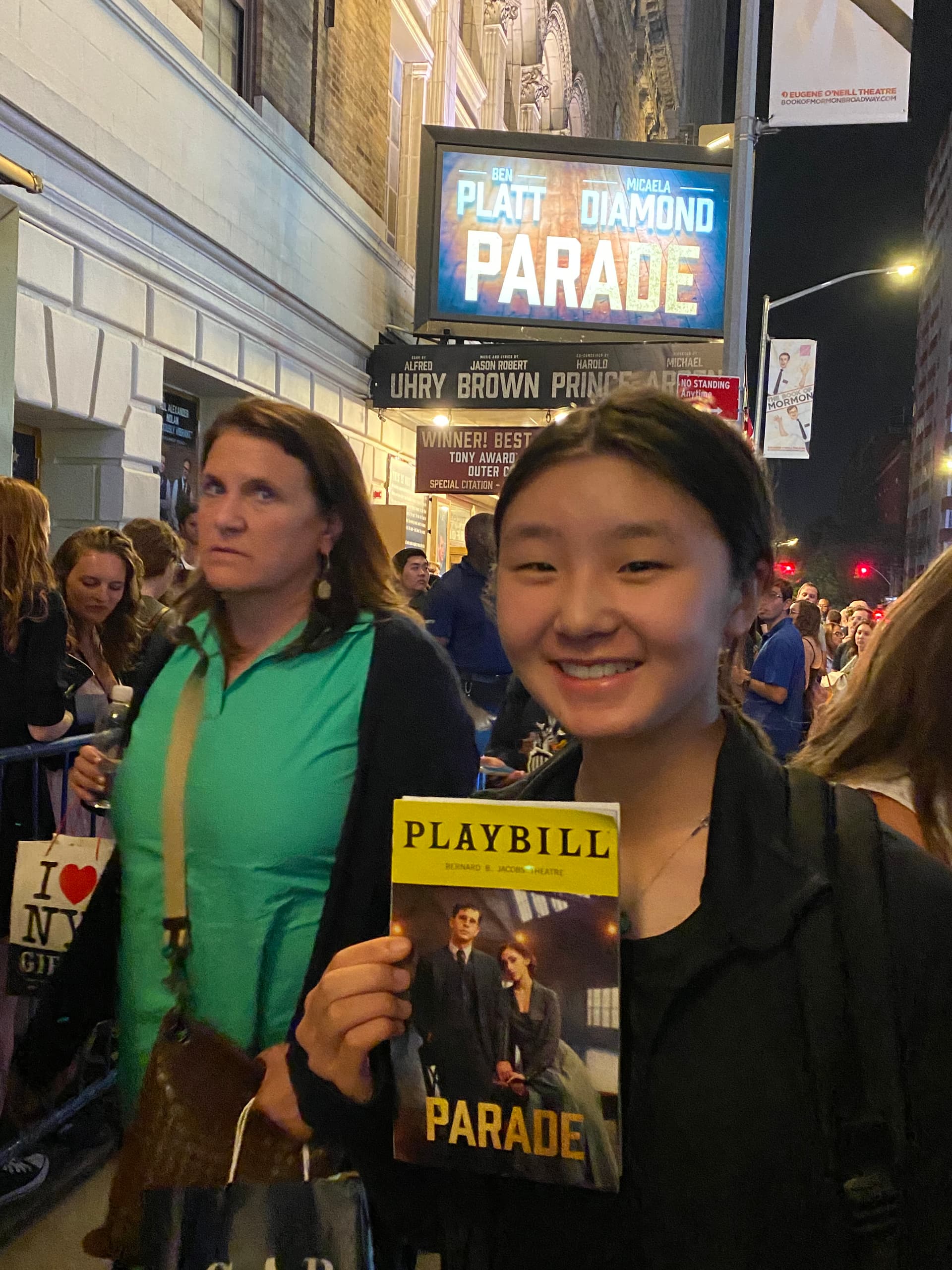
When Parade returned to Broadway at the Bernard B. Jacobs Theatre on March 16, 2023, it brought back a musical rooted in one of the most disturbing episodes of American legal history: the 1913 trial and 1915 lynching of Leo Frank. Set in Georgia, Parade tells the story of Leo Frank, a Jewish factory superintendent accused of murdering 13-year-old Mary Phagan, an employee at the National Pencil Company in Atlanta. Frank was convicted in a highly sensationalized trial. After Georgia governor John M. Slaton commuted his death sentence to life imprisonment in 1915, a group of men abducted Frank from prison and lynched him near Marietta, Georgia. The musical centers both Leo and his wife, Lucille Frank. At first their marriage is emotionally restrained. As Lucille becomes increasingly convinced of the injustice surrounding her husband's prosecution, she transforms into his most determined advocate. Songs including “The Old Red Hills of Home,” “There Is a Fountain/It Don’t Make Sense,” “Real Big News,” “This Is Not Over Yet,” “All the Wasted Time,” and “Sh’ma” examine antisemitism, racism, sensational journalism, political ambition, regional identity, and the dangerous transformation of accusation into collective certainty. Unlike many historical musicals, Parade offers no comforting escape from what happened. The audience enters knowing history cannot be rewritten.
Historical Era
Although Parade was originally produced on Broadway in 1998, its story takes place primarily between 1913 and 1915, in a South still shaped by the aftermath of the Civil War, Reconstruction, Jim Crow segregation, racial violence, and intense regional resentment. Leo Frank was a Northern-born Jewish man living in Atlanta—a city attempting to present itself as a modern industrial center while remaining deeply shaped by racial and social hierarchies. Mary Phagan's murder became more than a criminal case. It became a vehicle through which anxieties about industrialization, class, gender, regional identity, race, and antisemitism could be projected onto one defendant. The musical places those forces around Leo rather than treating his prosecution as an isolated miscarriage of justice.
Historical & Cultural Context
The real Leo Frank case became a national controversy. Frank was convicted in 1913, but questions about the evidence and conduct surrounding his trial produced campaigns both demanding his execution and advocating reconsideration of his conviction. A central prosecution witness was Jim Conley, a Black factory worker whose testimony implicated Frank. The racial dynamics were extraordinarily complicated: in Jim Crow Georgia, white prosecutors relied upon a Black man's testimony to convict a Jewish defendant, while Frank's defenders sometimes employed racist arguments to redirect suspicion toward Conley. That complexity matters. Parade is not simply a story in which prejudice operates along one axis. It depicts a society structured by overlapping racial, religious, class, and regional hierarchies, with different groups occupying profoundly unequal positions within them. Governor Slaton eventually commuted Frank's death sentence after reviewing the case. The political consequences were severe. Soon afterward, Frank was kidnapped from prison and lynched.
Antisemitism and the Creation of an Outsider
Leo's identity as both Jewish and culturally Northern contributes to his isolation. He lives in Atlanta but does not feel fully part of it. The musical establishes this immediately through “The Old Red Hills of Home.” While Atlanta celebrates Confederate Memorial Day and constructs a romantic memory of the Confederate past, Leo observes the celebration from a distance. That positioning is crucial. Before he is accused of anything, the musical establishes him as someone perceived as not entirely belonging. Once Mary is murdered, that difference becomes easier to weaponize. The show demonstrates how prejudice often works not by creating difference from nothing but by turning an already perceived difference into supposed evidence of danger.
Journalism and the Manufacture of Public Opinion
Parade is also a musical about media power. Reporter Britt Craig recognizes that Mary Phagan's murder can become an enormous story. In “Real Big News,” tragedy becomes opportunity. Newspapers do not merely report public outrage; sensational coverage helps create and intensify it. That makes Parade strikingly relevant to the broader history of American media. The case demonstrates how easily the distinction between legal guilt and public guilt can collapse when repetition, sensationalism, prejudice, and political pressure reinforce one another. Long before social media, information could already become viral. The technology was simply different.
Justice, Politics, and the Crowd
The musical repeatedly asks whether a legal system can remain independent when public opinion has already reached a verdict. Prosecutors face political incentives. Newspapers need stories. Crowds demand punishment. Officials understand that defending an unpopular defendant may carry enormous personal consequences. The case therefore becomes larger than the courtroom. Even when Governor Slaton uses his legal authority to commute Frank's sentence, extrajudicial violence overrides that decision. The lynching represents the complete collapse of legal process: a crowd decides that its version of justice matters more than law itself. That is one reason Parade remains such an unsettling historical musical. It is not merely about whether one trial reached the wrong conclusion. It asks what happens when institutions become vulnerable to the political emotions surrounding them.
The 2023 Revival
The 2023 revival, directed by Michael Arden, originated as a concert presentation at New York City Center before transferring to Broadway. Its staging was deliberately restrained. Rather than creating an elaborate realistic reconstruction of 1910s Atlanta, the production emphasized historical documentation. Projections displayed photographs, names, dates, newspaper material, and other imagery connected to the actual events. That choice repeatedly reminded audiences that they were not watching a purely fictional tragedy. These people existed. Mary Phagan existed. Leo and Lucille Frank existed. The lynching happened. The production therefore operated somewhere between musical theater, historical reconstruction, and memorial.
Ben Platt and Micaela Diamond
The revival starred Ben Platt as Leo Frank and Micaela Diamond as Lucille Frank. Their relationship provides the musical's emotional center. At the beginning, Leo and Lucille's marriage appears awkward and distant. Leo struggles to connect emotionally, while Lucille initially seems uncertain about how forcefully she can challenge the political and legal forces surrounding them. The crisis changes both. Lucille becomes increasingly assertive, refusing to accept passivity as her husband's fate. Leo becomes more emotionally open. By “All the Wasted Time,” they finally reach an intimacy that might have taken years under ordinary circumstances. That creates one of the musical's cruelest ironies. They learn how deeply they love one another precisely when time is disappearing.
Revival as Reinterpretation
The 2023 production also demonstrated why revivals matter historically. A revival is not simply an opportunity to perform an old musical again. The world receiving it has changed. When Parade originally opened in 1998, audiences encountered the Leo Frank case from one historical moment. By 2023, renewed public discussion of antisemitism, racial violence, political polarization, misinformation, and attacks on democratic institutions inevitably shaped how audiences interpreted the same material. That relevance became disturbingly literal when neo-Nazi protesters gathered outside the first preview of the Broadway revival. The event demonstrated that the prejudice represented inside the theater could not safely be confined to history. The production's historical argument therefore became impossible to treat purely as retrospective.
Historical Significance
The original 1998 Broadway production had a relatively short run, despite winning Tony Awards for Best Book and Best Original Score. Over time, however, Parade developed a much stronger reputation through regional, international, concert, and revised productions. The 2023 revival fundamentally changed its place in the Broadway canon. It received six Tony Award nominations and won Best Revival of a Musical and Best Direction of a Musical for Michael Arden. That trajectory is itself historically important. Some musicals become canonical immediately. Others require decades before audiences and artists fully recognize their significance. Parade demonstrates how revival can function as historical reevaluation—not simply preserving a work, but changing its position within theater history.
Memory and the Meaning of Parade
The title initially refers to the Confederate Memorial Day parade surrounding the beginning of the story. But “parade” gradually acquires a darker meaning. Crowds gather. People march together. Public emotion becomes collective identity. The same human capacity that allows communities to celebrate together can also allow prejudice to become socially reinforced. The musical therefore repeatedly contrasts the individual with the crowd. Leo is complicated, awkward, imperfect, and human. The crowd transforms him into a symbol. Once someone becomes a symbol, it becomes easier to stop seeing the person. That may be Parade's most enduring warning.
Why It Resonates With Me
What I find most powerful about Parade is the way it connects law, media, prejudice, and public opinion. Leo Frank's fate is not produced by a single institution acting alone; newspapers, prosecutors, politicians, witnesses, and crowds all contribute to an environment in which accusation begins to function as certainty. That makes the musical especially meaningful to me because it shows that legal history cannot be understood only by reading statutes and court decisions—we also have to understand the social forces surrounding them. I also think the 2023 revival demonstrates exactly why revivals belong in a living Broadway history. The facts of the Leo Frank case did not change between 1998 and 2023, but the audience did. A revival allows the same work to encounter a new historical moment—and sometimes that new moment makes an old story feel frighteningly unfinished.